The best transmission oil change pump depends on how you plan to move fluid: the Jewheg bottle pump suits simple transfers from quart bottles, while the Ojtrtdr and VEVOR systems offer larger reservoirs and vehicle adapters. For manual operation, consider AIGMlSON or FOUR UNCLES. Compare capacity, how the pump works, and the included fittings before choosing; transmission fill ports and service procedures vary by vehicle.
| Product | Best For | Key Feature |
|---|---|---|
| Jewheg Fluid Pump | Transfers from quart bottles | 8 cc per stroke; fill-tube adapter |
| Ojtrtdr 3L Pump | Controlled pressurized transfer | Pressure gauge and 13 adapters |
| VEVOR 10L System | Larger fluid-service jobs | 10-liter capacity and two-way operation |
| AIGMlSON 3L Pump | Manual garage or outdoor use | No power source required |
| FOUR UNCLES 3L Kit | Manual filling across vehicles | 12 refill adapters |
Jewheg Quart-Bottle Fluid Pump

Best for: DIY owners who want to pump fluid directly from a standard quart bottle. The pump is designed for bottles with a 28 mm cap and dispenses 8 cc per stroke, giving the user manual control over the transfer.
A butterfly-style “third hand” adapter helps hold the fill tube in the fill hole while pumping. The listed uses include transmission and differential fluid, as well as other fluids and maintenance tasks. It can be used on cars, trucks, RVs, boats, and motorcycles.
Why it was selected: Its bottle-mounted design is a straightforward option for small transfers without a separate reservoir. Limitation: Its 8 cc-per-stroke output means filling a transmission can require many strokes, and it is intended for compatible quart bottles.
Ojtrtdr 3L Pressurized Transfer Pump

Best for: Users seeking a pressurized transfer system with flow-control features. This 3-liter pump has a pressure gauge, a 90-degree shut-off valve, and 13 ATF adapters. The listing says it connects to shop air for fluid transfer and includes a pressure relief valve.
Why it was selected: Its gauge and shut-off valve provide visible pressure monitoring and a way to control flow, while the adapter set supports a range of vehicle applications. Follow the stated safety directions: secure the cap before pressurizing, keep pressure at or below the listed 40 PSI maximum, and release pressure through the side valve before disconnecting the hose adapter.
Limitation: This is not the simplest choice for someone who wants a basic hand pump; pressure management and the specified connection steps are part of its operation.
VEVOR 10L Two-Way ATF System
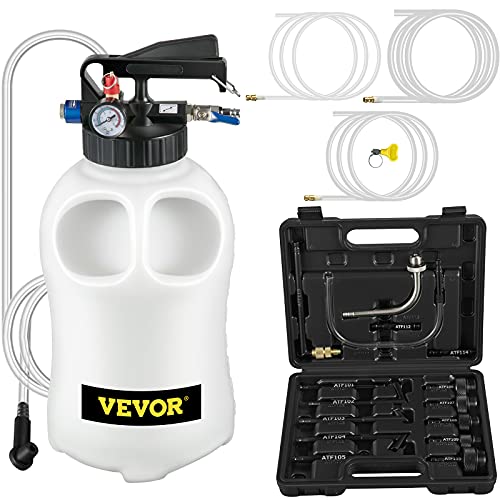
Best for: Buyers who need a larger reservoir for fluid service. The VEVOR system holds 10 liters and includes 14 common adapters for a range of automobiles. Its listed examples include BMW, Porsche, VW, Honda, and Audi.
The two-way control system uses a blue screw knob and a flow-direction valve to switch between extracting and dispensing fluid. This makes it more flexible than a pump intended only to push fluid into a fill port.
Why it was selected: The larger capacity and reversible flow function are useful when a job calls for more fluid or extraction as well as dispensing. Limitation: The 10-liter reservoir may be more capacity than needed for occasional, small-scale service. Confirm that a supplied adapter suits the vehicle before starting.
AIGMlSON 3L Manual Transmission Pump

Best for: Home-garage users who prefer manual pumping and do not want to rely on a power source. The listing says 10–20 pumps generate suction. Its 3-liter semi-transparent HDPE reservoir is described as resistant to corrosion and aging.
The pump also has a wide-mouth funnel, a brass flow valve for adjusting pumping speed, and a multi-seal design intended to reduce dripping. Listed fluid uses include transmission fluid, motor oil, and coolant.
Why it was selected: Manual operation and a visible reservoir make it a practical option for controlled fluid handling in a garage or outdoors. Limitation: The 3-liter capacity may require refilling for larger jobs, and the user must provide the pumping effort.
FOUR UNCLES 3L Pump With 12 Adapters

Best for: Users who want a manual filling kit with multiple transmission refill adapters. This 3-liter system includes 12 adapters intended for a range of vehicle applications and uses a one-hand pumping design for steady fluid delivery.
The product listing also describes a reinforced hose-and-adapter connection intended to create a secure seal and help reduce spills. Why it was selected: Its adapter assortment makes it a candidate for owners or service users who work with different transmission fill connections.
Limitation: The listing does not identify individual vehicle fitments for each adapter. Check the connection dimensions and application details before relying on a particular adapter.
Buying Guide: How To Choose A Transmission Oil Change Pump
Do you need to extract fluid or refill the transmission?
Start by identifying the job. A bottle pump or manual dispenser is suited to transferring fluid into a fill point. A two-way system can both extract and dispense, according to its listed features. Do not assume that every transmission pump removes old fluid; check whether extraction is explicitly supported.
How much capacity is practical?
A 3-liter reservoir is a more compact choice for smaller transfers, while the VEVOR’s 10-liter capacity suits jobs where holding more fluid is useful. A quart-bottle pump uses the bottle itself as its supply, but its 8 cc-per-stroke output can make transfer slower. Match capacity to the service procedure and the amount of fluid required.
Will the adapters fit your vehicle?
Adapter count alone does not confirm fit. Compare the product’s adapter information with the vehicle’s transmission fill connection and service instructions. A pump that seals correctly can help control spills, but the wrong fitting may not connect securely.
Manual or pressurized operation?
Manual models avoid a separate power source but require pumping by hand. A pressurized model may offer gauge monitoring and flow controls, but it also requires careful setup and pressure release. Follow the manufacturer’s instructions, and never disconnect a pressurized hose before depressurizing the system.
What should you check before beginning?
Use the fluid specification and fill procedure provided for the vehicle, and confirm the pump and hose are suitable for the intended fluid. Protect against spills, keep fittings secure, and check fluid level according to the vehicle’s service directions. Do not treat a pump’s stated vehicle examples as confirmation of fit for every model.
Frequently Asked Questions
Can a transmission oil change pump remove old fluid?
Some pumps support extraction as well as dispensing, such as the VEVOR system described here. Other products are primarily transfer or refill pumps. Check the specific listing before buying for extraction work.
Is a 3-liter pump enough for transmission service?
It depends on the vehicle and the service procedure. Compare the required fluid amount with the reservoir capacity, and plan for refilling if the job needs more than 3 liters.
Are transmission pump adapters universal?
No universal fit is established by adapter count alone. Confirm that the supplied fitting matches the vehicle’s transmission fill connection before use.
What is the benefit of a pressure gauge?
A gauge lets the user monitor pressure during transfer. On the Ojtrtdr model, the listing also specifies a shut-off valve and a 40 PSI maximum safe pressure; follow its pressure-release instructions.
Can these pumps handle other fluids?
Some product listings identify additional fluid uses, such as differential fluid, motor oil, or coolant. Check the specific pump’s stated applications and avoid using it with fluids that are not listed.