The best tire gauge with a bleeder valve lets you measure pressure and release excess air without disconnecting from the tire. The JACO ElitePro Digital 100 PSI is a strong fit for everyday vehicle checks, while its 200 PSI version suits buyers who need a wider measuring range. For a non-digital option, consider the JACO ElitePro 100 PSI or AstroAI glow-dial gauge. The ETENWOLF T600 offers a digital display and a range up to 250 PSI.
| Product | Best For | Pressure Range |
|---|---|---|
| JACO ElitePro Digital 100 PSI | Everyday vehicle maintenance | Up to 100 PSI |
| JACO ElitePro Digital 200 PSI | High-pressure applications | Up to 200 PSI |
| JACO ElitePro 100 PSI | Battery-free checking | Up to 100 PSI |
| AstroAI Glow Dial | Reading in dim areas | 0–60 PSI |
| ETENWOLF T600 | Wide range and unit choices | 0–250 PSI |
JACO ElitePro Digital 100 PSI

This gauge is best for drivers who want a digital readout and a pressure range suited to routine car, truck, motorcycle, bike, RV, and trailer checks. JACO lists accuracy to ±0.50% of full scale, a 0.10 PSI display resolution, and a maximum reading of 100 PSI.
The reading stays on the display until the user presses the on button to reset it. Its built-in bleeder valve releases pressure in real time, so a user can lower an overinflated tire while monitoring the reading. The solid brass and steel construction, protective guard, flexible 10-inch hose, and 360-degree swivel chuck are useful for regular garage use and awkward valve angles.
Choose this if you want a digital gauge with a lower maximum range than the 200 PSI model. Limitation: its 100 PSI ceiling is not the right fit when the application requires readings above that range.
JACO ElitePro Digital 200 PSI

This is best for buyers who need a broad measuring range in a digital gauge. It reads up to 200 PSI and has a listed accuracy of ±0.50% of full scale, with 0.10 PSI display resolution. As with the 100 PSI model, the reading locks on the display and the bleeder allows pressure adjustment while the gauge remains connected.
Its 10-inch HybridFlex hose, 360-degree swivel angled chuck, and solid brass and steel construction support access to hard-to-reach valves. The chuck can be replaced with a compatible 1/4-inch NPT chuck, according to the product details.
Better for users whose applications may exceed 100 PSI or who prefer extra range. Limitation: buyers who only need routine passenger-vehicle pressure checks may not need its higher 200 PSI capacity.
JACO ElitePro Analog 100 PSI
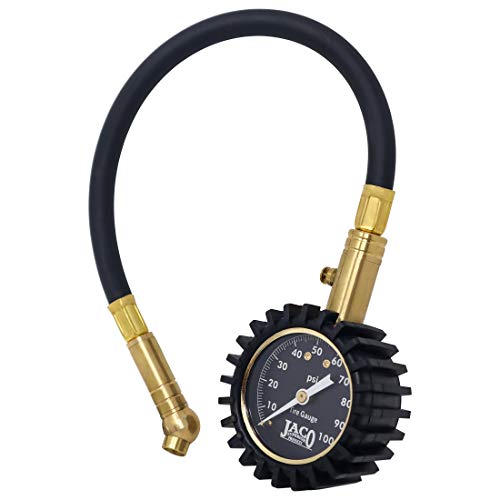
This model is best for buyers who want a mechanical gauge that does not rely on batteries. JACO lists calibration within ANSI standards at ±1.5%. Its solid brass body, shock-resistant protective guard, flexible leak-proof hose, and 360-degree swivel chuck are designed for routine pressure checks from different angles.
The built-in bleeder valve lets users reduce pressure in an overinflated tire. The 100 PSI range makes it a practical option when a digital display is not a priority and the required pressure falls within that limit.
Choose this if you want a battery-free gauge with pressure release built in. Limitation: it does not provide the digital display or 0.10 PSI readout resolution listed for the JACO digital models.
AstroAI Glow-Dial 0–60 PSI Gauge

This AstroAI gauge is best for users who prefer an analog dial that is easier to see in dim areas. Its glow-in-the-dark dial, brass components, stainless-steel construction, rubber hose, and 360-degree swivel chuck are listed features. The bleeder valve allows excess pressure to be released after checking a tire.
The flexible hose and rotating chuck are intended to help reach awkward valve stems on cars, trucks, and motorcycles. Choose this if a visible dial and a maximum range of 60 PSI meet your needs. Limitation: the 0–60 PSI range is narrower than the other featured gauges, so check your vehicle or equipment’s required pressure before choosing it.
ETENWOLF T600 Digital 250 PSI

The ETENWOLF T600 is best for buyers who need a high maximum range and selectable pressure units. It measures from 0 to 250 PSI, has a listed accuracy of ±0.5% of full scale, and displays readings in 0.1 PSI increments. One button controls power, resets the reading, and switches among PSI, BAR, and kPa.
The display holds the reading until reset. Its flexible rubber hose and 360-degree angled chuck help reach recessed valves, while the built-in bleeder releases pressure and lets users monitor changes in real time. The chuck uses a standard 1/4-inch NPT connection and can be replaced with a compatible one.
Better for users who need a broad range or alternate units. Limitation: its 250 PSI capacity may be unnecessary for routine passenger-car checks.
Buying Guide
What pressure range do you need?
Check the recommended tire pressure for your vehicle or equipment, then choose a gauge whose maximum range covers the intended measurement. A 60 PSI gauge can suit applications within that limit; 100, 200, and 250 PSI options provide progressively wider ranges. A higher maximum is not automatically more useful if your needs are modest.
Digital or analog: which is easier for you?
Digital models show a numeric reading and may include a hold function or unit selection. Analog models use a dial and do not require batteries, as described for the JACO mechanical gauges. Consider whether you prefer a number on a display, a dial, or a battery-free design.
How does the bleeder valve help?
A bleeder valve lets you release air from an overinflated tire after measuring it. Models with real-time pressure adjustment let you keep the gauge connected and observe the reading as pressure drops. The feature corrects excess pressure; it does not inflate a tire.
Do hose and chuck design matter?
A flexible hose and swivel chuck can make it easier to reach recessed or angled valve stems. If you need to use a different chuck, check the product’s connection details: some listed models specify a 1/4-inch NPT connection. Follow the product instructions to get a secure connection and reading.
Frequently Asked Questions
What does a tire gauge with a bleeder valve do?
It measures tire pressure and provides a way to release excess air. A user can reduce pressure when a tire is overinflated.
Can a bleeder valve add air to a tire?
No. A bleeder valve releases air. A separate inflator or air source is needed to add air.
Is a 100 PSI gauge enough for a car?
It may be sufficient when the required tire pressure is within the gauge’s range. Check the vehicle’s recommended pressure and select a gauge with a maximum reading above that requirement.
Are digital tire gauges more accurate than analog gauges?
Accuracy depends on the specific model, not only whether it is digital or analog. Compare each product’s stated accuracy and range before selecting one.
Why choose a gauge with a swivel chuck?
A swivel chuck can help position the gauge on valve stems that are angled or difficult to reach. A secure connection is important for taking a pressure reading.