The best TIG welder for auto body work depends on whether you need controlled heat for thin metal, a machine with several welding processes, or a dedicated tool for pulling dents. The ARCPEX is best for HF-start TIG on thin sheet metal and exhaust work; the HZXVOGEN and LOTOS offer broader process choices; and the SSimder adds timed spot mode for panels. For dent pulling rather than TIG welding, a VEVOR stud welder is the more targeted option.
| Product | Best For | Key Auto-Body Use |
|---|---|---|
| ARCPEX 200A HF TIG | TIG-focused repairs | HF-start TIG for thin sheet metal and exhaust |
| SSimder 5-in-1 | Thin-panel spot work | Timed spot mode and Lift TIG |
| LOTOS MIG225SP | Process flexibility | Spot welding, Lift TIG, and aluminum MIG |
| HZXVOGEN 200A | Multi-process capability | HF TIG, Pulse MIG, and spot welding |
| VEVOR 1.8KW Stud Welder | Dent pulling | Stud welding and controlled dent removal |
ARCPEX 200A HF TIG Welder

Best for: Buyers who prioritize TIG control for thin sheet metal, auto exhaust, and other steel repairs. The ARCPEX offers high-frequency, non-contact TIG starting, which avoids striking the tungsten against the workpiece. It also provides Stick welding as a second process.
The product listing specifies a maximum 200A output, a 60% duty cycle, and penetration capability on steel plate up to 5/32 inch. Hot Start and Anti-Stick functions are included for Stick welding. This is a more TIG-focused choice than the multi-process machines below.
Limitation: The listing describes TIG for stainless and mild steel, but does not list aluminum TIG capability. Check the required material and process before choosing it for a repair.
SSimder 5-In-1 Pulse MIG Welder

Best for: Garage users who want a machine with a dedicated spot mode for thin panels as well as Lift TIG. Its listed processes are Pulse MIG, spot, flux-core, Lift TIG, and Stick. The spot timer is intended to apply a fixed burst, while Pulse MIG is presented as a way to reduce spatter.
Dual-voltage 110V/220V operation and synergic control may suit buyers who want adjustable process options without manually setting every parameter. The digital display shows settings, and the machine is positioned for both home-garage and workshop use.
Limitation: This is not a TIG-only machine. Choose it for the combination of processes and timed spot feature, rather than if your main requirement is a dedicated TIG setup.
LOTOS MIG225SP Multi-Process Welder
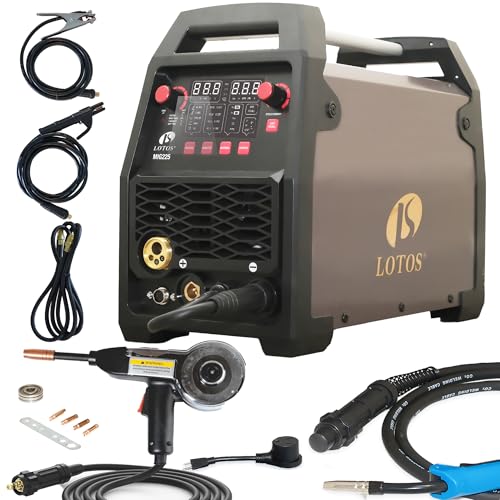
Best for: Buyers whose auto-body and related projects require more than TIG. The LOTOS supports gas MIG, flux-core, aluminum MIG with the included spool gun, Stick, Lift TIG, and spot welding. Its auto-synergic MIG setting helps select starting parameters, and the large LED screen displays settings.
The included spool gun is a notable distinction for projects involving aluminum, while spot mode and Lift TIG give the machine other repair options. It is a practical comparison pick for a shop or garage that expects to switch between processes and materials.
Limitation: The product listing says the TIG torch is not included. Account for that when comparing the setup with machines intended for TIG use.
HZXVOGEN 200A 7-In-1 Welder

Best for: Buyers seeking a broad set of processes, including HF TIG and spot welding. The listed functions include gas MIG, gasless flux-core MIG, Pulse MIG, HF TIG, Stick, plasma cutting, and spot welding. It also offers dual-voltage input and a stated maximum output of 200A.
The product features describe synergic settings that adjust current and wire feed based on selected material thickness, wire diameter, and mode. The listing also identifies fine-tuning options such as pre- and post-gas, crater adjustment, and 2T/4T operation. These features may appeal to users who want automatic setup plus manual adjustments.
Limitation: The listing includes several processes in one unit, so verify the included accessories and the setup needed for your specific TIG work before purchase.
VEVOR 1.8KW Stud Welder Dent Puller

Best for: Users repairing dents in steel car panels, not buyers seeking a TIG welder. This machine uses studs and a puller to draw out dents; it is a different auto-body repair method from TIG welding. Its seven welding modes are intended for different studs, and it provides automatic and manual operation.
Manual mode allows more control over individual weld spots for complex dents, while automatic mode is described for larger dents. It belongs in this comparison because dent pulling is a common body-repair task, but it should not be treated as a substitute for a TIG machine.
Limitation: The listed application is dent removal from steel body panels. Choose a TIG welder instead for joining metal or making TIG welds.
Buying Guide: Choosing a Welder For Auto Body Work
Do you need TIG welding or dent pulling?
TIG welding joins metal with a controlled arc and is useful for appropriate repair and fabrication tasks. A stud welder attaches pulling studs to a steel panel so a dent can be drawn out. These tools serve different purposes. Identify the repair method before comparing features.
Is HF start or Lift TIG the better fit?
HF start begins the arc without touching the tungsten to the workpiece, as described for the ARCPEX and HZXVOGEN. Lift TIG starts by touching and lifting the torch electrode. The SSimder and LOTOS list Lift TIG. Compare the starting method, included torch equipment, and the materials you plan to weld.
Would spot mode help with thin panels?
A timed spot mode delivers a short, controlled welding burst instead of a continuous bead. The SSimder and LOTOS list spot welding, and the HZXVOGEN also includes spot mode. Spot capability is distinct from TIG; confirm which process and accessories suit the panel repair you intend to make.
What should you check before buying?
- Input power: Compare the machine’s voltage requirements with the outlets available in your garage or shop.
- Process: Select TIG-focused equipment for TIG work, or a multi-process unit if MIG, Stick, spot, or other functions are also needed.
- Material: Confirm the machine’s listed capabilities for the metals involved. Do not assume every TIG-capable model welds aluminum.
- Included equipment: Check whether the torch and other process-specific accessories are supplied. The LOTOS listing, for example, says its Lift TIG torch is not included.
- Heat control: Thin sheet metal requires suitable settings and technique. A machine feature alone cannot guarantee a clean repair.
Frequently Asked Questions
Can a TIG welder remove a car dent?
A TIG welder is designed for welding, not pulling dents. A stud welder and dent puller, such as the VEVOR model above, is designed for that task on steel panels.
Which option listed has HF-start TIG?
The ARCPEX 200A and HZXVOGEN 200A listings specify HF TIG. HF starting initiates the arc without scratching the tungsten against the workpiece.
Which listed welder includes spot mode?
The SSimder, LOTOS, and HZXVOGEN listings include spot welding. The SSimder specifically describes a timer-controlled spot mode for thin panels.
Is Lift TIG the same as HF TIG?
No. They are different TIG arc-start methods. Lift TIG starts through contact and lifting, while HF start initiates the arc without contact.
Can every machine in this article weld aluminum with TIG?
No. The product listings do not establish aluminum TIG capability for every model. Verify the specific process, material capability, and accessories before buying.