For students, hobbyists, and curious minds, a hands-on small engine kit that runs can turn theory into tangible understanding. The following selections are designed to show how an air-fuel mixture and pistons translate into motion, sound, and mechanical insight. Each option offers a different level of detail, realism, and operation mode, helping learners explore internal combustion concepts while building a usable, visually engaging model.
The table below summarizes five kits chosen for a practical, engaging hands-on experience. Each entry highlights the core features that support learning through play and exploration.
| Product | Brand | Approx. Parts | Key Feature | Engine Type |
|---|---|---|---|---|
| Playz V8 Combustion Engine Model Kit | Playz Store | 270 Parts | Visible V8 with running action and engine sounds | Electric battery powered |
| Mould King Mini V8 Engine Kit | Mould King Store | 487 Parts | Transparent head and realistic turbocharger | Manual/Model engine |
| Karei V8 Engine Building Set | Karei Store | 1065 PCS | Dual operation modes, USB rechargeable motor | Electric/Manual |
| Mould King V8 Engine Building Blocks | Mould King Store | 2718 PCS | Large, detailed V8 with turbo design | Battery motor |
| V8 Engine Model Building Kit (BseSparklion) | BseSparklion Store | 905 PCS | Two-speed USB motor, realistic running | USB powered |
Playz V8 Combustion Engine Model Kit That Runs

The Playz V8 engine model kit delivers a hands-on experience that appeals to both adults and kids. It is a working replica of a classic 8-cylinder internal combustion engine, designed to engage learners with a realistic build and interactive components. The kit guides builders through assembling pistons, cranks, belts, and exhaust valves, culminating in a running miniature engine that produces audible feedback similar to a real motor. It operates with a set of three AA batteries, encouraging experimentation with power, timing, and mechanical fit. This kit is particularly suitable for classrooms, family projects, and individual STEM exploration.
Features emphasize a practical understanding of engine action: moving pistons, realistic cable connections, and audible engine sounds that make the classroom or workshop experience more immersive. The combination of tactile assembly and functional output helps users connect theoretical concepts—such as piston motion and crankshaft rotation—with observable outcomes. As a learning tool, it supports multi-age collaboration, encouraging discussion about why certain engine parts must synchronize to generate motion and power.
Mould King Mini V8 Engine Kit That Runs

The Mould King Mini V8 Engine Kit focuses on high-detail modeling and accurate internal features, including a transparent cylinder head for visualizing piston movement and a realistic turbocharger. This kit is well-suited for dedicated hobbyists who appreciate precision engineering and display-worthy results. The combination of detailed components and visible internals makes it an effective tool for understanding how an eight-cylinder engine is designed to balance power, torque, and efficiency. It appeals to teens and adults who want a robust, collectible model that also demonstrates core engine principles in action.
Built for educational display and demonstration, this kit emphasizes the aesthetics of engine architecture while enabling hands-on exploration of how moving parts—valves, pistons, and turbocharging—interact. The transparent design offers a direct view into the engine’s operating cycle, fostering curiosity about the interactions that produce motion and sound.
Karei V8 Engine Building Set

The Karei V8 Engine Building Set offers a dual-mode operation—manual cranking and electric motor—along with an USB-rechargeable motor. This versatility supports varied learning preferences and environments, from hands-on manual study to powered demonstrations. With 1065 pieces, builders experience a substantial, intricate assembly that mirrors real-world automotive engineering from crankshaft dynamics to valve timing. The kit is positioned for teens and adults who want a comprehensive, multistep project that culminates in a functioning V8 engine model. The rechargeable motor also reduces downtime related to battery management during extended building sessions.
Educationally, the set provides a platform to discuss energy conversion, mechanical advantage, and the role of gear systems in controlling speed and direction. The combination of both manual and electric modes helps learners compare different modes of operation, and the wealth of components supports exploring engineering concepts beyond simple assembly.
Mould King V8 Engine Building Blocks

The Mould King V8 Engine Building Blocks kit emphasizes large-scale construction with 2718 pieces and a battery-powered motor. The kit showcases a turbocharged V8 concept, providing a visually striking model that illustrates how high-output engines achieve rapid power delivery. Its size and complexity make it a strong choice for dedicated builders, STEM classrooms, or collector-focused projects where a dramatic, interactive display is valuable. The kit’s compatibility with common building block systems also helps ensure future expandability for more advanced projects.
From an educational perspective, this model supports exploring advanced topics like airflow, turbocharging, and power-to-weight relationships. The sheer number of parts invites problem-solving, planning, and iterative testing to optimize the engine’s running performance and mechanical reliability.
V8 Engine Model Building Kit That Runs (BseSparklion)
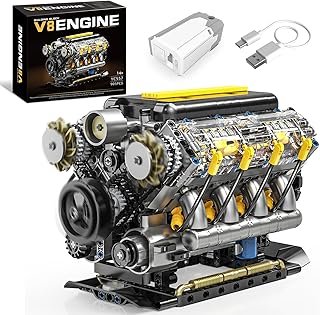
The V8 Engine Model Building Kit by BseSparklion features a two-speed USB rechargeable motor for realistic running action, simulating engine sounds and activity without traditional batteries. With 905 pieces, this kit balances complexity with accessibility, offering a thorough engineering experience without being overwhelming. The model’s emphasis on realistic operation—pistons, valve train, turbocharger, and exhaust—provides a robust educational platform for illustrating internal combustion dynamics, timing, and mechanical coordination in a compact, durable form factor.
Educational uses include demonstrations of energy transfer, synchronization between moving parts, and how different operating modes (two-speed motor) alter engine behavior. The kit’s reusable power solution and reliable construction support extended classroom or home projects focused on mechanical systems and STEM literacy.
Buying Guide: Key Considerations When Choosing a Small Engine Kit That Runs
- Learning goals: Choose a kit that matches your target age and knowledge level, from introductory concepts to advanced mechanics and assembly complexity.
- Power and operation mode: Consider whether you prefer electric motor, manual crank, USB rechargeable power, or a combination. USB rechargeable options reduce ongoing battery management during long projects.
- Realism vs. display: If the goal is in-depth learning, look for features like visible pistons, valve trains, turbochargers, and transparent cylinder heads. For display-only interest, visually detailed models still offer valuable insights without full mechanical realism.
- Complexity and size: Larger kits with thousands of pieces offer deeper exploration but require more time and space. Smaller sets can provide focused demonstrations of core concepts with quicker results.
- Durability and materials: Durable plastics and quality gears help ensure smoother operation and longer-lasting demonstrations, especially in classroom settings or shared spaces.
- Compatibility and expandability: Some kits are designed to work with other building systems, enabling future upgrades or combined projects for broader STEM learning.
- Audiovisual feedback: Models with engine sounds or moving pistons give tangible feedback on how components interact, reinforcing concepts like timing and synchronization.
- Educational context: Consider accompanying guides or manuals that explain engineering principles in clear terms and provide suggested experiments or demonstrations for instructors and learners.
- Safety and age appropriateness: Verify age recommendations and ensure small parts are appropriate for the learner’s age to prevent choking hazards and ensure safe handling during assembly.
- Cost vs value: Compare part count, realism, and the included features to determine which kit provides the best balance of learning value and engagement for your budget.
Overall, the best small engine kit that runs combines hands-on assembly with observable engine dynamics, enabling learners to translate theoretical concepts into practical understanding. When selecting, prioritize how the kit will be used—individual study, classroom demonstration, or family collaboration—and choose a model that aligns with those learning objectives while offering durable construction and engaging operation.