Finding the right tire pressure monitoring system (TPMS) for large vehicles like semi trucks, campers, and trailers can improve safety, reduce downtime, and optimize fuel efficiency. This guide reviews five top TPMS options that cover long sensing distances, solar charging, flow-thru sensors, and color displays. All models are designed to monitor multiple tires simultaneously, alert drivers to dangerous pressure or temperature shifts, and simplify installation for fleet or owner-operator use.
| Product | Key Benefit | Sensor Count | PSI Range |
|---|---|---|---|
| GUTA T1/T2/T3 Trailer TPMS | Real-time multi-tire display with booster option | Up to 10 | 0–188 |
| GUTA GT80 Color Display TPMS | Full-color touchscreen, flow-thru sensors | 10 | 0–188 |
| Hieha RV TPMS Solar | 24-hour solar powered continuous monitoring | 6 | 0–198 |
| Taimster 4.5″ Solar TPMS | Compact solar charger with long sensing distance | Up to 10 | 0–199 |
| GUTA RV Trailer TPMS (10 Sensors) | Long-range monitoring for larger vehicles | 10 | 0–188 |
GUTA Trailer TPMS T1/T2/T3: 10 Sensors, 6 Alerts

The GUTA T1/T2/T3 system emphasizes real-time monitoring with a large display that shows data for up to 10 tires on a single page. It is designed for large vehicles, with a pressure range up to 188 psi and temperature monitoring up to 185 °F. An optional signal booster helps maintain reliable signal over long distances and through interference, which is essential for multi-axle trailers and semi trucks. The kit supports easy setup by locking the current pressure as a reference and allowing alarm thresholds from +25% to -15% of that reference.
Alerts cover high and low tire pressure, high temperature, fast leaks, missing sensor signals, and low sensor battery. This TPMS prioritizes safety and fuel economy by ensuring tire parameters are kept within safe ranges, enabling proactive maintenance during long-haul trips. The system is expandable and compatible with multiple trailer configurations, making it a practical choice for fleets managing several trailers or campers.
GUTA GT80 Color Touchscreen TPMS for RVs and Trailers
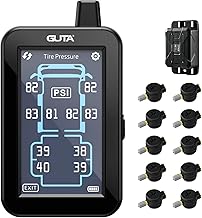
The GT80 model stands out with a full-color touchscreen that presents real-time tire pressures (0–188 PSI) and temperatures on a prominent vertical display. It uses flow-thru sensors to allow inflation without sensor removal, simplifying maintenance for heavy-duty tires. Factory pre-labeled sensors and factory pairing reduce setup time, while wireless pairing enables quick installation for RVs, trailers, or tow vehicles. An optional signal booster extends wireless range up to 164 feet, which is helpful when monitoring larger vehicle fleets or long trailers from the driver’s seat.
Designed for fleet management and long trips, this TPMS supports easy switching between vehicle types and emphasizes visibility, reliability, and ease of use. It’s a compelling option for drivers who value a modern, intuitive interface with robust safety alerts and long-range connectivity.
Hieha RV TPMS Solar with 6 Sensors

Hieha’s solar-powered TPMS offers 24-hour continuous operation with a 5000 mAh battery, reducing the need for frequent charging. The system uses a high-precision Freescale chip for accurate readings and lower power consumption, with a tolerance of about +/- 1 psi. It provides real-time monitoring with multiple alarms, including air leakage, low/high pressure, high temperature, sensor data loss, and low battery alerts. The combination of solar power and precise sensors helps ensure tire health on long-distance trips where charging opportunities may be limited.
Durability features include waterproof, dust-proof, anti-theft, and anti-flying protections, making it suitable for harsh road conditions. This model is particularly attractive for semi-truck operators who require reliable data without frequent manual intervention, especially on rolling stock and long-haul routes.
Trailer Tire Air Pressure Monitoring System: 4.5″ Solar TPMS

This 4.5-inch solar TPMS features a 4.5″ LCD for easy reading of all tire data, including pressure and temperature. It supports 4–14 tires with a signal booster and is designed for trailers, RVs, trucks, cars, coaches, fifth wheels, and motor homes. Solar charging pairs with Type-C backup to ensure continuous operation, even during extended travel in low-light conditions. The flow-thru sensors enable quick inflation without removing sensors, improving maintenance efficiency and reducing downtime for fleets and individual operators alike.
Accuracy is stated at ±2 psi, which is sufficient for routine monitoring and preventive maintenance. Note that the system is not compatible with certain short or rubber valve stems, so compatibility checks are advised before purchase. This option balances compact design with practical range and modern charging options for everyday use.
GUTA RV Trailer TPMS: 10 Sensors, Long Sensing Distance

This model focuses on long-distance sensing and compatibility with commercial fleets. It monitors tire pressure from 0 to 188 PSI and is designed for RVs, motorhomes, trailers, large trucks, and semi-trucks. The system offers six alert types, including rapid deflation and extreme pressure/temperature changes. It’s expandable from four to up to 24 tires, making it adaptable for growing fleets or larger vehicles. Pre-labeled sensors and factory pairing simplify setup, with a reference pressure feature that streamlines alarm configuration within +25% to -15% of baseline pressures.
Fleet managers may appreciate the scalability and the comprehensive alert system, which helps reduce the risk of tire-related failures on long hauls and cross-country routes. The long-range connectivity and robust alarm suite are designed to support consistent monitoring across diverse vehicle configurations.
Buying Guide: Key Considerations For Selecting A TPMS For Semi Trucks And Trailers
- Sensor count and vehicle type: Choose a system that supports your total tire count and scales as your fleet grows. Consider whether you need 4, 6, 8, 10, or 24 tires and if you’re monitoring trailers, RVs, or semi-trucks.
- Display and readability: Large color screens or high-contrast displays improve readability in daylight and at night. Touchscreen interfaces can speed up setup and daily checks.
- Alert types and thresholds: Look for multiple alert modes (pressure, temperature, leaks, sensor power) and the ability to customize thresholds relative to a reference pressure.
- Power source and reliability: Solar charging reduces maintenance, but ensure there is a backup or fast charging for periods with limited sun. Battery life and charging options affect uptime.
- Flow-thru vs traditional sensors: Flow-thru sensors enable inflation without removing sensors, reducing downtime during tire maintenance, especially on trailers.
- Signal range and boosters: Long sensing distance helps with multi-axle trailers and remote setups. A signal booster can extend coverage in larger vehicles.
- Installation and maintenance: Pre-labeled sensors, factory pairing, and straightforward pairing reduce installation time. Consider sensor replacement and battery life expectations.
- Durability and weather resistance: Look for waterproof, dustproof, anti-theft features, and robust construction suitable for road conditions and varying climates.
- Fleet management and data access: Some systems offer centralized monitoring, data export, or remote alerts—useful for fleet managers and multiple drivers.
The right semi truck or trailer TPMS delivers real-time data, proactive alerts, and easy maintenance to improve safety and reduce downtime. When evaluating options, consider the scale of your operation, the terrain you encounter, and how you manage tire maintenance across multiple vehicles. This approach helps ensure you select a TPMS that aligns with your safety, efficiency, and cost-saving goals.