Maintaining proper tire pressure is essential for RV safety, fuel efficiency, and tire life. This article highlights five top-rated RV tire pressure monitoring systems (TPMS) designed for RVs, trailers, and trucks, with features ranging from solar charging to color LCD displays and extended sensor ranges. Each product section includes key specs, real-world usability, and installation notes to help you choose confidently.
| Product | Key Features | Sensor Type | Display | Range |
|---|---|---|---|---|
| Tymate TM2 TPMS | 6 alarm modes, solar charging, 4 external sensors | External | Color LCD | 0-87 PSI |
| Tymate TM7 TPMS | 6 alarm modes, color LCD, dual USB charging | External | Color LCD | 0-87 PSI |
| Hieha TPMS | 24-hour solar powered, real-time monitoring | External | LED display | 0-198 PSI |
| Marcala 4-Sensor TPMS | 50 ft extended range, solar & USB charging | External | LCD | 0-98 PSI |
| Marcala 6-Sensor TPMS | 50 ft extended range, real-time alerts, auto-dimming LCD | External | LCD with backlight | 0-144 PSI |
Below are five TPMS options selected for their balance of accuracy, ease of use, and RV suitability. The profiles cover solar charging, long-range sensors, and clear, readable displays for all driving conditions.
Tymate TM2 RV TPMS With Solar Power

The Tymate TM2 system includes four external sensors and a color LCD monitor, designed to operate with a wide alarm range. Six alarm modes help detect fast leaks, high or low pressure, temperature changes, and sensor health issues. The reference pressure is set automatically after pairing, simplifying threshold setup to a flexible range of +25% PSI to -15% PSI. The system supports solar charging as the primary power source, with USB or vehicle cigarette lighter charging as a fallback, ensuring the monitor remains powered on longer trips.
Key considerations include sensor longevity and water resistance. TM2 sensors are IP67-rated, offering good protection against dust and water exposure, and they’re designed for up to six months per CR1632 battery. The manufacturer notes a typical accuracy around 3 PSI, which is adequate for RV monitoring, particularly when alarms alert you to rapid changes. Installation is straightforward, with factory pre-paired sensors, reducing setup time in camp.
Tymate TM7 TPMS With Color Display

The TM7 expands on Tymate’s TPMS with real-time readings and a vivid color LCD screen. It features six alarm modes, including high/low pressure, fast leakage, high temperature, sensor low battery, and signal loss. The system is designed for easy plug-in power via the vehicle’s cigarette lighter socket, making it a practical upgrade for older vehicles without factory TPMS. With dual USB charging included, TM7 also serves as a mobile device charger during long road trips.
Readouts are displayed in either Celsius or Fahrenheit and can be shown in PSI or BAR, depending on user preference. The combination of rapid sensor data and the color LCD helps drivers quickly assess tire health at a glance, reducing the risk of blowouts or flats on challenging RV routes. For flexibility, this unit can be a cost-effective upgrade for campers and DIYers who want reliable, on-the-road monitoring without a major installation workflow.
Hieha Solar RV TPMS With Four Sensors

The Hieha TPMS emphasizes uptime with a 24-hour continuous battery life from solar power and a 5000mAh battery. It provides real-time monitoring with several alerts, including air leakage, low/high pressure, high temperature, sensor data loss, and low battery. The system’s data accuracy and rapid abnormal event detection aim to prevent tire-related incidents on long RV trips. Its rugged design aims to withstand common travel challenges, with waterproof and dust-proof construction for use in various weather conditions.
Hieha’s solar-first design reduces maintenance needs, while a robust alert system keeps drivers informed about tire health while on the road. The setup is suitable for RVs, travel trailers, and motorhomes that require reliable monitoring without frequent recharging, especially in remote camping spots. Overall, it offers a strong balance of energy efficiency and timely warnings for critical tire conditions.
Marcala 4-Sensor Solar TPMS For RVs
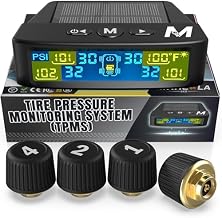
Marcala’s 4-sensor TPMS focuses on extended range and solar charging, with a display designed for clear readability day or night. It supports monitoring up to 98 PSI and includes a 50-foot extended range, making it suitable for larger RVs and towing setups. The system updates every second while driving, providing live pressure and temperature alerts, and it switches to battery-saving mode when parked to extend sensor life. USB charging is also available to ensure continuous operation on cloudy days.
The kit’s upgraded sensors and hub simplify installation and reduce the risk of sensor misalignment. A bright LCD with auto-dimming helps preserve battery life while maintaining visibility in various lighting conditions. For RV owners who travel with long tows or in remote areas, Marcala’s 4-sensor system offers a dependable balance of range, clarity, and solar charging convenience.
Marcala 6-Sensor RV TPMS With Extended Range

This Marcala version expands to six sensors for broader coverage and a higher PSI ceiling of 144 PSI. It emphasizes real-time alerts during driving, with a RGB LCD screen that automatically dims to save power. Like the 4-sensor version, it relies on solar charging with USB backup and offers six alarm modes to address typical RV tire concerns, including high/low pressure, temperature shifts, and sensor health checks. The extended range is particularly beneficial for longer RVs, trailers, or tow setups.
Users should note the need for correct sensor placement on each tire, as with all external TPMS systems. The 50-foot range and rapid data updates are designed to deliver up-to-the-minute readings, reducing uncertainty while maneuvering large vehicles. Marcala’s 6-sensor kit targets RV owners seeking comprehensive monitoring and clear, actionable alerts during travel and camp stays.
Buying Guide: Key Considerations For Selecting An RV TPMS
- Sensor configuration: Decide between 4, 5, or 6 sensors based on your vehicle’s tire count and whether you use extra axles or trailers. More sensors typically provide fuller coverage but may require more setup.
- Power strategy: Consider solar-powered units for low maintenance, plus USB or cigarette-lighter backups for cloudy days or extended trips. Check battery life expectations for each model.
- Alarm features: Look for multi-alarm support (high/low pressure, rapid leak, high temperature, sensor health). An alarm system that distinguishes between driving and parked modes can help manage battery usage.
- Display readability: Color LCD and backlit displays improve visibility in bright sun or night conditions. Auto-dimming can help conserve power on longer trips.
- Pressure range: Ensure the system covers your tires’ PSI range (e.g., up to 87 PSI, up to 144 PSI, or beyond) and matches your RV’s typical inflation levels.
- Installation and pairing: Pre-paired sensors save setup time. Look for IP-rated sensors for durability, especially if you frequently travel on dusty or wet roads.
- Cost vs. return: Higher sensor counts and longer ranges add value for large RVs or frequent tow setups. Balance price with features that address your specific travel patterns.
- Data connectivity: Some models offer more frequent sampling or faster data transmission. Consider how quickly you need alerts to trigger for safety-critical situations.
In choosing an RV TPMS, assess your vehicle configuration, climate and road conditions, and how much you value features like solar charging and real-time alerts. The models discussed here provide a spectrum of options—from compact, plug-in systems to more robust, solar-powered setups—so you can identify a TPMS that best suits your travel style and safety priorities.