A right angle tire pressure gauge makes it easier to reach valve stems tucked behind spokes, wheel covers, or other tight spaces. The PUIBERS 60 PSI gauge is best for low-light checks, Counteract is a compact motorcycle and ATV option, and Accu-Gage suits buyers who want a hose and a specified ANSI Grade B rating. GERCHWAY offers a 45-degree chuck with a longer hose, while JACO is the better fit for higher-pressure and dually applications.
| Gauge | Best For | Pressure Range |
|---|---|---|
| PUIBERS | Low-light vehicle checks | Up to 60 PSI |
| Counteract | Motorcycle and ATV tires | 5–50 PSI |
| Accu-Gage | Flexible reach and rated accuracy | 5–60 PSI |
| GERCHWAY | Long hose and angled access | Up to 100 PSI |
| JACO EliteProPlus | High-pressure and dually tires | Up to 160 PSI |
PUIBERS 60 PSI Mechanical Gauge

This analog gauge is best for drivers and riders who need a readable display and access to awkward valve stems. Its flexible hose and 90-degree chuck are designed for Schrader valves, and the luminous dial is intended to be easier to read in low light.
The 60 PSI scale fits many car, motorcycle, bicycle, dirt bike, and SUV checks. The listing describes a brass body, bronze Bourdon tube movement, no battery requirement, and accuracy meeting ANSI Grade B40.1 standards. Choose this model if visibility and a mechanical readout matter.
Limitation: Its scale tops out at 60 PSI, so it is not the right choice when the required tire pressure exceeds that range.
Counteract 5–50 PSI Motorcycle Gauge

The Counteract analog gauge is best for motorcycle and ATV owners who want a straightforward metal tool for hard-to-access valve stems. Its 90-degree head is specifically described as helping reach difficult valve positions, and the readout covers 5–50 PSI, also shown as 50–300 kPa.
Its all-metal construction is a practical reason to consider it if you prefer a mechanical gauge without a digital display. The focused pressure range can suit lower-pressure motorcycle and ATV checks. Choose it when access and a simple dial matter more than a broad measurement range.
Limitation: The 50 PSI maximum is lower than the range of several alternatives here, and the listed features do not specify a hose or glow-in-the-dark dial.
Accu-Gage RA60X With Hose

Accu-Gage is best for buyers who want a right-angle chuck, a flexible hose, and a stated commercial-grade accuracy specification. It measures 5–60 PSI and is designed for standard valves. The maker says its Bourdon tube movement is not affected by temperature, humidity, altitude, or air-stream contaminants.
The listing states that the gauge meets ANSI B40.1 Grade B specifications. Its braided hose is intended to help reach awkward valves on cars, trucks, and motorcycles, while the mechanical dial retains the reading after removal from the tire. Choose this model for a combination of reach and a clearly stated standard.
Limitation: The upper limit is 60 PSI, so check your vehicle’s required pressure before choosing it for higher-pressure tires.
GERCHWAY 100 PSI Angled Gauge

GERCHWAY is best for buyers who want an angled chuck with a longer reach and a higher scale than the 50–60 PSI options. Its 45-degree chuck is intended for tight valve stems, and the 12-inch hose adds flexibility for cars, bikes, motorcycles, and racing tires. The dial glows in the dark, according to the product details.
The listed pressure capacity is 100 PSI, and the stated accuracy is ±1%. Choose this gauge if a 45-degree angle is suitable for your wheel access and you want a hose long enough to position the dial away from the valve.
Limitation: Its chuck is angled at 45 degrees, not 90 degrees. Buyers specifically requiring a 90-degree head should choose another option.
JACO EliteProPlus 160 PSI Gauge
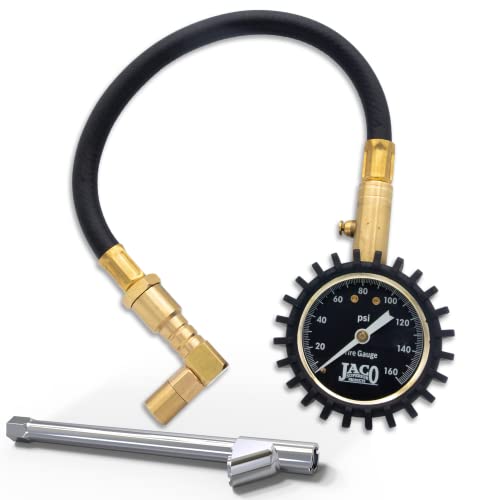
The JACO EliteProPlus is best for buyers who need a broad pressure range or want to service dually wheels. It measures up to 160 PSI, includes a 90-degree air chuck, and also has an extended dual-foot chuck for dually wheels on semi-trucks, RVs, and trailers.
The listing describes brass components, a shock-resistant rubberized guard, a 360-degree swivel chuck, and a built-in air bleeder for reducing pressure in overinflated tires. Its stated accuracy is within ANSI standards at ±1.5%. Choose this model if the dual-foot chuck and pressure range are useful for your vehicles.
Limitation: The 160 PSI scale may be more range than needed for ordinary passenger-car checks; select a gauge whose scale suits your tires.
Buying Guide: How To Choose A Right Angle Tire Pressure Gauge
Which chuck angle fits your valve stems?
A 90-degree chuck is a direct match if you specifically need a right-angle connection. A 45-degree chuck, such as the GERCHWAY design, can also help with tight access but has a different orientation. Consider the clearance around your wheel and whether a hose makes it easier to position the gauge.
What pressure range should you choose?
Check the vehicle or tire manufacturer’s recommended pressure and choose a gauge whose scale covers that value. The options here range from a 50 PSI maximum to 160 PSI. A wider range is useful for varied applications, but the pressure reading should still be easy to interpret for your usual tires.
Do you want a dial, hose, or extra functions?
All five recommendations are mechanical dial gauges, so batteries are not listed as necessary. A hose can help with awkward valve locations, while a luminous dial can help in dim conditions. A built-in bleeder, as listed for the JACO, allows pressure release from the gauge. Compare these functions against your actual needs rather than choosing by feature count alone.
Frequently Asked Questions
What is a right angle tire pressure gauge used for?
It helps measure tire pressure when a straight connection is difficult to position on a valve stem. The angled chuck can improve access around wheels and other obstacles.
Is a 45-degree chuck the same as a 90-degree chuck?
No. They describe different chuck angles. If your requirement is specifically a 90-degree chuck, select a product that lists that angle.
Are mechanical tire pressure gauges battery-powered?
The mechanical gauges described here do not require batteries, according to their product details. Their readings are shown on a dial.
Can one gauge work for cars and motorcycles?
Several listed gauges are described for both cars and motorcycles. Confirm that the gauge’s valve type and pressure range suit the tires you plan to check.
Should I choose the highest PSI range?
Not automatically. Choose a scale that covers the required pressure for your tires. A higher maximum is useful only if your applications need that added range.