When you need reliable, professional-grade charging power, these pro-level car battery chargers deliver serious performance for 12V and 6V systems. This guide highlights top choices for automotive technicians, fleet managers, and DIY enthusiasts who demand fast charging, advanced features, and durable construction. Each product is evaluated for power, versatility, safety, and suitability for heavy-use scenarios. The top five selections include professional-ready units with high-current capability, smart charging, and desulfation or repair modes where applicable. Use this to compare how each charger fits your workload and vehicle types.
Summary table of selected products:
- Product: Schumacher DSR Pro INC100 — Best for professional service with high current and ECU reprogram support.
- Product: TowerTop 25A Max Pro — Best for fast, heavy charging with smart auto features.
- Product: TowerTop 25A Pro+ — Best for versatile 6V/12V maintenance and engine start.
- Product: NOCO GENIUS1 — Best for compact, all-in-one maintainers with temperature compensation.
- Product: Porsche Charge-o-mat Pro — Best for Porsche owners and cigarette-lighter charging, storage readiness.
Schumacher DSR Pro INC100: Heavy-Duty 100A Pro Charger
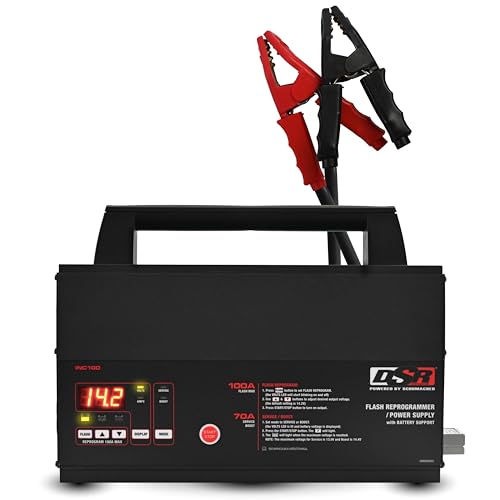
The Schumacher DSR Pro INC100 is designed for professional use with 100-amp peak capability and multiple voltage modes. It provides a constant power output during vehicle ECU reprogramming tasks and supports a maximum service mode around 13.5 volts. This makes it a strong fit for automotive technicians who perform frequent diagnostics and reprogramming on 12V batteries. Best for professional shops and fleets needing reliable, high-current maintenance and reprogramming support.
Who it’s best for and why: Professional automotive technicians and service centers that require sustained high current during ECU reprogramming, or users who need a robust service-mode option. The model is selected for its durable build and enterprise-grade capability.
Limitations: High current requires compatible vehicle systems and proper safety procedures. Real-world use may require additional accessories or knowledge of vehicle electrical architecture.
TowerTop 25A Max Pro Battery Charger

TowerTop’s 25A Max Pro combines fast charging with smart automation and comprehensive protection. It offers four current settings (3A/15A/25A/AUTO) to suit various battery sizes, with a claimed 3.5-hour full charge for a 100Ah battery. The charger emphasizes efficiency, with an 85% charge efficiency and automatic battery detection, desulfation, and repair features. It includes built-in protections like reverse polarity, overcharge, and short-circuit safeguards, and is ETL certified for user safety.
Who it’s best for and why: Pros needing rapid top-offs on mid- to large-capacity lead-acid batteries, including hobbyists and small repair shops. Choose this if you want strong current output combined with automatic maintenance features.
Limitations: As a smart charger, it relies on proper battery compatibility and may not replace a dedicated jump-start tool for completely drained or damaged batteries.
TowerTop 25A Pro+ Battery Charger
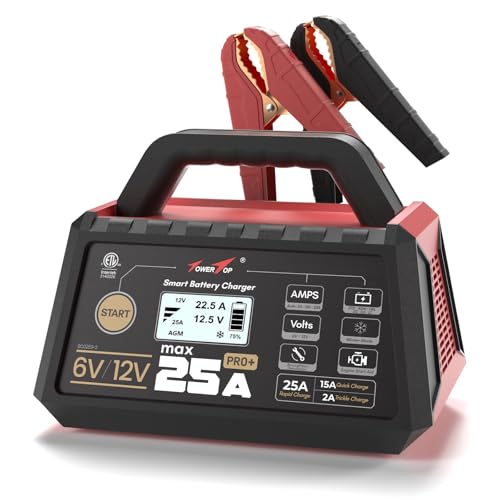
The TowerTop Pro+ extends the 25A platform with 6V/12V versatility, engine-start capability, and an automatic desulfation/repair mode. With four current settings (2A/15A/25A/AUTO), it targets quick recovery for a wide range of lead-acid, AGM, and LiFePO4 batteries. The unit emphasizes safety features and a compact, plug-and-play design for shop or home use. Best for users who need a single charger that covers multiple battery chemistries and frequent maintenance tasks.
Who it’s best for and why: Techs and serious DIYers who work with mixed battery fleets and require cross-chemistry charging. The Pro+ is a strong all-in-one option for daily maintenance and occasional engine starting support.
Limitations: Some battery types, like deeply discharged lithium packs, may require specialized equipment or different charging parameters. Always verify compatibility with your battery type before use.
NOCO GENIUS1: Compact 1A Smart Charger

The NOCO GENIUS1 is a compact, all-in-one charging solution ideal for motorcycle and car batteries. It supports 6V and 12V lead-acid and certain lithium chemistries, and adds a desulfator with overcharge protection and temperature compensation. The integrated thermal sensor automatically adjusts charging based on ambient temperature to prevent damage. Best for owners who want a small, portable unit that maintains batteries with precision without occupying much space.
Who it’s best for and why: Individuals seeking a portable, reliable maintainer for a small toolbox or garage, especially those with mixed battery types. It’s a better fit for infrequent maintenance rather than heavy service workloads.
Limitations: Lower current capacity means it isn’t ideal for rapid charging or large, deeply depleted batteries. It’s best as a maintenance device rather than a primary charging source.
Porsche Charge-o-mat Pro Battery Maintainer

The Porsche Charge-o-mat Pro is designed to work with Porsche models and other vehicles that charge via cigarette lighter. It is a dedicated maintainer to keep batteries charged during long storage periods and is easy to use by plugging into the car’s 12V outlet. Best for Porsche owners or anyone seeking a cigarette-lighter-based charging solution for long-term battery maintenance.
Who it’s best for and why: Vehicle owners who store cars for extended periods and want a straightforward solution to prevent battery drain. Choose this if you prioritize a simple, in-car charging setup for storage readiness.
Limitations: It relies on the vehicle’s 12V outlet; not suitable for charging completely dead batteries or heavy-use maintenance outside storage scenarios.
Buying Guide
What to consider when buying a pro-grade car battery charger:
- Current capability: For large batteries or fleet work, prioritize high amperage (25A–100A) and stable service modes. Lower-current units fit lighter maintenance roles or smaller batteries.
- Battery chemistry support: If you own LiFePO4 or AGM batteries, verify compatibility and any reconditioning or desulfation modes that protect long-term health.
- Auto vs manual modes: Auto-detect and auto-maintain features reduce monitoring time, but manual override may be necessary for specialized tasks or testing.
- Protection features: Look for overcharge protection, reverse polarity, short-circuit safeguards, and temperature compensation to prevent damage.
- Usability: Consider plug-and-play ease, connector compatibility, and whether the unit supports engine-start assistance for hard-to-crank vehicles.
- Size and portability: If you need on-the-go service, compact designs with adequate cooling and heat management are beneficial.
- Reliability and build quality: For professional use, select chargers with solid construction, clear labeling, and durable cables.
Frequently Asked Questions
- What is the difference between a battery charger and a maintainer?
Answer: A charger actively charges a depleted battery, while a maintainer keeps a fully charged battery at an optimal float level to prevent discharge during storage. - Can I use a high-current charger on a small battery?
Answer: It can be safe if the charger has proper automatic current limiting and voltage control. Always follow the battery manufacturer’s recommended charging rate. - Is temperature compensation necessary?
Answer: Yes, it prevents overcharging in heat and undercharging in cold environments, preserving battery life and performance. - Do I need professional-grade chargers for a personal garage?
Answer: If you frequently service vehicles, work with large batteries, or perform ECU reprogramming, a pro-grade charger offers necessary features and reliability. - Are lithium batteries widely supported by car battery chargers?
Answer: Some models support LiFePO4 and other lithium chemistries; always verify compatibility before use to avoid damage. - What should I avoid when using high-current chargers?
Answer: Avoid charging damaged or deeply discharged batteries without proper diagnosis, and never bypass safety protections.