The best power outlets for cars depend on what you need to plug in: choose a 300-watt inverter for more AC capacity, a compact 150-watt model for basic device charging, or a 200-watt option with extra USB ports. The picks below include compact designs and different combinations of AC outlets and USB charging. Check the power requirements of your devices before connecting them.
| Product | Best For | Listed Output |
|---|---|---|
| BESTEK 300W Inverter | Multiple AC and USB devices | 300W continuous |
| YSOLX 300W Inverter | More charging ports | 300W; six output ports |
| PiSFAU 200W Inverter | Compact multi-device charging | 200W |
| PiSFAU 150W Inverter | Basic AC and USB charging | 150W continuous |
| FOVAL 150W Inverter | Small road-trip setup | 150W continuous |
BESTEK 300W Car Power Inverter

Best for: Travelers who want two AC outlets and USB charging in one compact adapter. This BESTEK inverter converts 12–17V DC to 110V AC and lists 300 watts of continuous power, with 700 watts of instantaneous power.
It has two AC outlets and two USB ports rated at 4.8A, according to the product details. Its phone-sized design and 32-inch cigarette-lighter plug make it easier to pack for trips or camping than a larger power station.
Consideration: The 300-watt rating is the continuous output, so add up connected devices’ power needs and keep the total within the inverter’s capacity.
YSOLX 300W Inverter With Six Ports

Best for: Drivers who need to charge several kinds of devices at once. This 300-watt inverter has two 110V AC outlets and four USB-C/A charging ports rated at 24W, for six total output ports.
The product information lists phones, cameras, laptops, game consoles, and other electronics among its intended uses. An intelligent cooling fan is designed to operate more quietly and steadily during extended use, which may suit road trips or outdoor activities.
Consideration: The listed 300-watt capacity is shared across the inverter’s use; the product details do not specify a separate wattage allocation for each AC outlet.
PiSFAU 200W Compact Power Inverter

Best for: Buyers who want more USB connections than a basic inverter provides. The PiSFAU converts 12V DC to 110V AC and includes two standard AC outlets and four USB charging ports.
Its compact size is listed as 2.7 by 1.4 by 5 inches, with a weight of 8.5 ounces or more. The manufacturer also describes its circuit design as energy-efficient and its heat-dissipation system as intended to reduce operating noise.
Consideration: At 200 watts, it provides less stated continuous output than the 300-watt options, so it is better suited to lower-power device combinations.
PiSFAU 150W Inverter With Dual Protection

Best for: Drivers who need a modest amount of AC power and USB charging for everyday electronics. This model lists 150 watts of continuous output and 300 watts of peak power, plus AC outlets and two USB ports.
Its smart chip and built-in fuse are described as a double-protection mechanism. If the inverter detects a fault, the listed response is to stop output and show a red indicator. The product names devices such as laptops, tablets, lights, and small electronics as potential uses.
Consideration: Its 150-watt continuous rating is lower than the other inverters here, so check device requirements carefully before use.
FOVAL 150W Portable Car Inverter
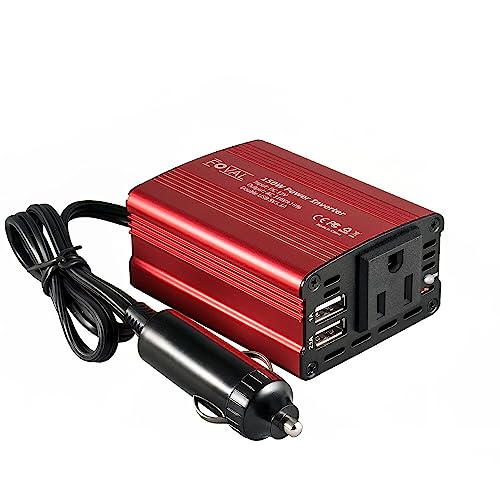
Best for: Travelers seeking a small adapter for one AC device and USB charging. FOVAL lists 150 watts of continuous 12V DC-to-110V AC output, one AC outlet, and two USB ports with a combined maximum output of 3.1A.
The manufacturer describes the unit as credit-card-sized, measuring 3.2 by 2.5 by 1.5 inches, with an aluminum shell. It is a space-saving choice for a glove compartment or travel bag when a two-outlet inverter is not necessary.
Consideration: It has only one AC outlet and a 150-watt continuous rating, making it less suited to running several AC-powered devices.
Buying Guide: How To Choose A Car Power Outlet
Do you need AC outlets or USB ports?
Choose an inverter with AC outlets for devices that use a standard wall-style plug. USB ports are more convenient for phones and other USB-powered devices. Compare the number and type of ports with the devices you plan to charge; port count alone does not indicate how much power each device receives.
How much wattage should you look for?
Check the input label or manual for each device and compare its power needs with the inverter’s continuous-output rating. The products here list between 150 and 300 watts of continuous output. Peak or instantaneous power is a separate figure and should not be treated as the continuous rating.
Will it fit your vehicle and travel routine?
These listed inverters connect through a vehicle cigarette-lighter adapter. Consider the cord length, size, and number of devices you expect to use. Compact models are easier to store, while models with more outlets may reduce the need for separate charging adapters.
Frequently Asked Questions
What does a car power inverter do?
It converts a vehicle’s DC power into AC power for compatible devices. Many models also include USB ports for charging USB-powered electronics.
Can I plug any household appliance into a car inverter?
No. Confirm that the device’s power requirements fit within the inverter’s output rating. The product details provided do not establish compatibility with every appliance.
Is a 300-watt inverter always better than a 150-watt model?
Not necessarily. A 300-watt model offers a higher stated continuous output, while a 150-watt model may be enough for lower-power needs and can be more compact.
What should I check before connecting multiple devices?
Check the inverter’s total output rating and the power requirements of every connected device. Also review the product’s port specifications, since AC and USB outputs may have different limits.