Need a dependable piston air compressor or vacuum pump for industrial, lab, or workshop use? This guide compares five strong options, outlining who each product suits best, key specs, and practical buying tips. The top picks cover oil-less and oil-lubricated designs, various power levels, and different vacuum capacities to match common tasks—from light household jobs to professional maintenance and process needs.
| Product | Best For | Key Benefit |
|---|---|---|
| Gast Piston Air Compressor/Vacuum Pump | Industrial setups needing moderate airflow and vacuum | Balanced CFM and vacuum with rugged build |
| Thomas / Gardner Denver THOMAS 0.1 hp | Compact, oil-free operation for dispensing and ventilation | Oil-free, continuous duty design |
| Pinelicorn Oil-Free 7CFM | Quiet, oil-free pumping with robust aluminum body | Aluminum construction, high efficiency |
| Medo LA-120 Piston Air Pump | Onsite wastewater, aquaculture, or liquid mixing | Die-cast piston, outdoor UL-approved |
| Jiabailie 110V Mini Diaphragm Vacuum Pump | Lab or small-scale vacuum with silent operation | Oil-free, dual cooling fans, low heat |
Gast Piston Air Compressor/Vacuum Pump, 1/6HP

Best for compact industrial workstations that require both air supply and vacuum capability in a small footprint. The unit features a 1/6 HP motor, 2 cylinders, and a rocking piston design for steady airflow. It provides a free air delivery of around 1.50 CFM at zero pressure and up to 0.9 CFM at higher vacuum levels, with a max vacuum near 26″ Hg. It operates at 115 VAC, 60 Hz, and has oil-less lubrication for easier maintenance. Best for workshops where space is limited and reliability is essential. Limitations include moderate maximum vacuum and airflow compared with larger units.
- Best for: Small industrial applications needing both air pressure and vacuum
- Good for: Light dispensing, small automation, and ventilation tasks
- Not ideal for: Heavy-duty continuous vacuum or high-volume air demands
Thomas/Gardner Denver THOMAS Piston Air Compressor
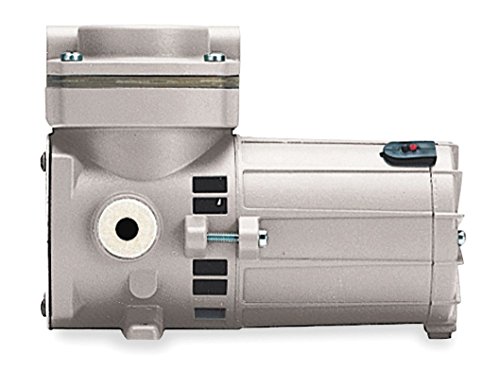
This compact unit is designed for mixing or dispensing tasks where a simple, oil-free air supply is beneficial. It combines a rocking piston with oil-free operation, suitable for environments like food and beverage and medical settings where oil contamination must be avoided. The model emphasizes continuous operation capabilities without the need for oil lubrication, which simplifies maintenance. Best for: small scale, clean-process applications. Limitation: lower overall airflow compared with larger industrial pumps.
- Best for: Oil-free, continuous-duty needs in small setups
- Better for: Dispensing, ventilation, and low- to mid-volume air/vacuum tasks
- Avoid if: High-volume air or high vacuum is required
Oil-Free Air Compressor Motor, 7CFM, 110V

This 7 CFM, 110V unit emphasizes oil-free operation and a robust, corrosion-resistant aluminum body. Its 1100-watt motor runs up to 1400 RPM, delivering consistent pumping power for air compression or vacuum tasks in industrial settings. The copper motor winds support improved thermal performance and energy efficiency. Best for: maintenance tools and small workshops needing quiet operation and low maintenance. Limitation: aluminum design, while strong, may not match heavier cast-iron durability in extreme conditions.
- Best for: Quiet, efficient oil-free pumping
- Better for: Light to mid-demand air/vacuum tasks in maintenance shops
- Avoid if: You require maximum durability in rugged environments
Medo LA-120 Piston Air Pump

The Medo LA-120 is positioned for demanding onsite wastewater, aquaculture, and liquid mixing tasks. It features die-cast piston construction and UL approval for outdoor use, making it a practical option for outdoor or field work where reliability matters. This model emphasizes robust physical construction and suitability for environments where exposure to moisture or weather is a consideration. Best for: outdoor or industrial environments requiring dependable piston pumping. Limitation: lacks detailed airflow or vacuum figures in readily available specifications.
- Best for: Outdoor or rugged environments requiring durability
- Better for: Wastewater, aquaculture, and liquid mixing applications
- Avoid if: You need precise, high-CFM vacuum numbers in advance
Jiabailie 110V Mini Diaphragm Vacuum Pump

This 110V mini diaphragm pump emphasizes silent operation and oil-free design with a cast aluminum shell and copper motor windings. It features dual cooling fans to manage heat, a low-noise profile, and a compact form factor suitable for labs and small workshops. Best for: quiet, oil-free vacuum needs in controlled environments. Limitation: diaphragm pumps typically have lower vacuum capacity compared to larger piston systems.
- Best for: Quiet lab or small-scale vacuum tasks
- Better for: Oil-free operation with predictable, low-noise performance
- Avoid if: High vacuum volume is required for heavy-duty tasks
Buying Guide: Key Considerations For Piston Air Compressors & Vacuum Pumps
Choosing the right piston air compressor or vacuum pump depends on your use case, environment, and maintenance expectations. Consider the following questions and factors to compare options effectively.
- What is the required airflow (CFM) at the operating pressure or vacuum level (inHg)? Higher CFM supports heavier air demands; vacuum ratings matter for suction-heavy tasks.
- Oil-free vs oil-lubricated: Do you need oil-free for clean processes (food, medical, dispensing) or is an oil-lubricated design acceptable for rugged use?
- Voltage and power: Is the unit compatible with standard US outlets (110-120V) and your available power supply?
- Duty cycle and continuous operation: Will the unit run continuously or only intermittently? Outdoor or workshop environments may influence this choice.
- Material and build: Cast iron versus aluminum bodies impact durability, heat dissipation, and weight.
- Noise level: For workplaces or labs, quieter models reduce disturbance and can be a decisive factor.
- Size and portability: Are you mounting the unit or moving it between sites? Footprint and weight matter.
- Maintenance needs: Oil-filled components require regular checks; oil-free designs simplify servicing but may have different life expectations.
FAQ
- What is the difference between piston and diaphragm pumps?
Piston pumps deliver higher airflow and vacuum in many applications, while diaphragm pumps offer oil-free operation and lower noise, making them suitable for quiet environments. - When should I choose oil-free over oil-lubricated?
Oil-free is preferred for clean processes (food, medical, dispensing) and environments where oil contamination is a concern; oil-lubricated designs can handle heavier workloads and longer runtimes in rugged settings. - What does CFM indicate?
CFM stands for cubic feet per minute and measures how much air the pump can move at a given condition; higher CFM means more air flow. - How important is vacuum rating?
Vacuum rating (in Hg) shows how strong the suction is. Higher vacuum levels enable handling of tighter seals and finer vacuum tasks. - Can these units operate outdoors?
Some models are UL-listed and rated for outdoor use, but always verify the enclosure and weather ratings before outdoor deployment. - Is maintenance required for graphite or cast iron pumps?
Yes. Regular inspection of seals, valves, and lubrication (where applicable) extends service life and maintains performance.