The best mechanical tire pressure gauge depends on the pressure range, display style, and features you need. The ETENWOLF glow-dial gauge is best for low-light readings, while the AstroAI pencil set is a compact two-gauge option. For a dial gauge with a bleeder and flexible hose, consider the JACO ElitePro 100 PSI. The TIRETEK 60 PSI model offers a straightforward analog design, and ETENWOLF’s pencil pair covers two pressure ranges.
| Gauge | Best For | Range |
|---|---|---|
| ETENWOLF Glow Dial | Reading in low light | 0–75 PSI |
| AstroAI Pencil Two-Pack | Compact everyday use | 10–75 PSI |
| JACO ElitePro | Higher-pressure tires and pressure adjustment | Up to 100 PSI |
| TIRETEK Analog Dial | Simple mechanical checks | Up to 60 PSI |
| ETENWOLF Pencil Two-Pack | Two different pressure ranges | 10–50 and 20–120 PSI |
ETENWOLF Glow Dial Tire Pressure Gauge

This analog gauge measures from 0 to 75 PSI and has a large glow dial intended to make readings easier in darkness or low light. The manufacturer states that it is manually calibrated to ANSI B40.1 Grade A, with accuracy of plus or minus 1% of span.
Best for: Drivers who check tire pressure at night or want a broad-use gauge for vehicles such as cars, motorcycles, pickups, SUVs, RVs, and ATVs. Its illuminated dial and stated calibration standard distinguish it from the pencil-style choices.
Limitation: Its maximum reading is 75 PSI, so choose another model if your required pressure range exceeds that limit.
AstroAI Pencil Tire Pressure Gauge Two-Pack

This set includes two pencil gauges with a 10–75 PSI range. The stainless-steel components are designed to resist rust and corrosion, and the product features an integrated deflator valve, chuck, and ABS indicator bar. It measures PSI, kPa, and bar, with stated accuracy of plus or minus 2% of span.
Best for: Buyers who prefer a compact mechanical gauge or want two gauges for separate vehicles or locations. The included valve stem caps add replacement parts.
Limitation: The gauge must not be used above its 75 PSI maximum, as the product information warns that doing so can permanently damage it.
JACO ElitePro 100 PSI Tire Pressure Gauge
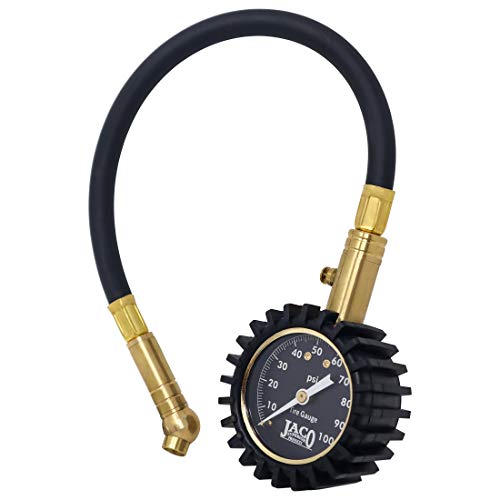
The JACO ElitePro reads up to 100 PSI and works without batteries. Its stated accuracy is within ANSI standards at plus or minus 1.5%. A solid-brass body, shock-resistant protective guard, flexible HybridFlex air hose, and 360-degree swivel chuck are among its listed features. A built-in bleeder valve lets users reduce pressure in an overinflated tire.
Best for: Buyers who want a dial-style gauge with a higher range and a way to bleed excess air during pressure adjustments. The swivel chuck can help access a valve from different angles.
Limitation: This model has a 100 PSI scale, which may be more range than needed for buyers looking for a simple low-pressure gauge.
TIRETEK 60 PSI Analog Tire Gauge
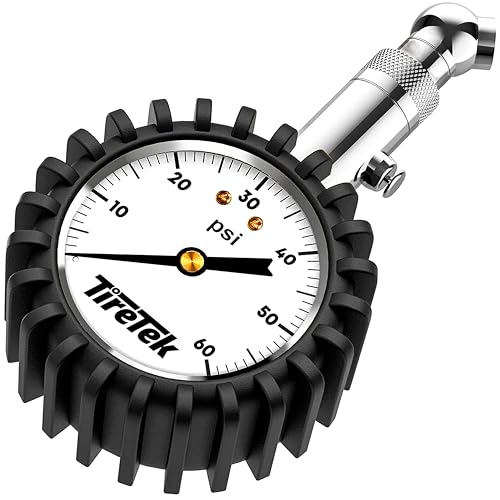
This mechanical dial gauge is calibrated to ANSI B40.1 Grade B, with stated accuracy of 2%. It has a steel-and-brass construction, an extended 5 mm chuck tip, and a rubber cover intended to protect the gauge and improve grip. It requires no batteries and is listed for use with cars, motorcycles, trucks, bikes, SUVs, RVs, and ATVs.
Best for: Drivers who want a direct-reading analog gauge with a protective cover and a 60 PSI maximum scale. Its stated range and simple mechanical operation suit buyers who do not need a higher-pressure model.
Limitation: The 60 PSI maximum makes it a poor choice when the required tire pressure is above that range.
ETENWOLF Pencil Gauge Two-Pack

This set pairs a 10–50 PSI gauge with a 20–120 PSI gauge, providing two distinct measurement ranges. Both are made with a zinc-alloy head and stainless-steel body. The manufacturer states that the gauges are manually calibrated to ANSI B40.1 Grade B: accuracy is 2% of span in the middle half of the range and 3% in the lower and upper quarters.
Best for: Buyers who need a compact pencil format and want separate gauges for different pressure requirements. The wider-range unit reaches 120 PSI, while the lower-range option focuses on pressures up to 50 PSI.
Limitation: Read the range printed on each gauge before use; the two gauges do not cover the same pressure span.
Buying Guide: How To Choose A Mechanical Tire Pressure Gauge
What pressure range do you need?
Check the recommended cold tire pressure for your vehicle and compare it with the gauge’s scale. Choose a gauge whose maximum reading comfortably covers the pressure you need to measure. A 60 or 75 PSI model may suit many routine checks, while a 100 or 120 PSI range offers more headroom for higher-pressure applications.
Dial gauge or pencil gauge?
A dial gauge has a face that displays the reading, and some models include features such as a glow dial, hose, or bleeder. A pencil gauge is a slim, compact option with a sliding indicator. Choose based on which display you can read and handle comfortably.
Which accuracy and features matter?
Compare the stated calibration standard and accuracy figures rather than assuming all mechanical gauges are identical. A bleeder valve is useful for reducing excess pressure; a swivel chuck or extended tip may help with valve access. For use in dim conditions, a glow dial may be preferable. Mechanical gauges do not require batteries.
How should you use a tire gauge?
Check tire pressure when tires are cold, if possible, and follow the vehicle manufacturer’s recommended pressure. Press the gauge firmly onto the valve stem to obtain a reading, then compare it with the recommended figure. Do not exceed the gauge’s stated maximum pressure.
Frequently Asked Questions
Are mechanical tire pressure gauges accurate?
Accuracy varies by model. Check the manufacturer’s stated accuracy and calibration standard, such as the ANSI B40.1 details listed for these products.
Do mechanical tire gauges need batteries?
No. These listed gauges use mechanical displays and do not rely on batteries for pressure readings.
Is a higher PSI range always better?
No. Choose a range that covers the pressure you need to check. A gauge with a higher maximum can offer flexibility, but the scale should still be readable for your typical measurements.
Can a tire gauge lower tire pressure?
Some models include a bleeder valve for releasing excess air. The JACO ElitePro listed here has a built-in air bleeder; other gauges may require a separate method to adjust pressure.