A license plate rubber spacer can help reduce rattling, limit contact with your vehicle’s finish, or create a small cushion behind a plate. For a simple bumper-style part, the Retro-Motive glass stop bumpers are the most directly targeted option. GNSZSN and NJNYLLC offer foam backing pads for broader noise and scratch protection, while the uxcell rubber rings suit buyers who need a specific spacer size. Aujen’s silicone frame is an alternative when you want cushioning around the plate rather than separate spacers.
| Product | Best For | Key Detail |
|---|---|---|
| Retro-Motive Glass Stop Bumpers | Small bumper-style contact points | Fits a 5/16-inch hole |
| GNSZSN Anti-Rattle Pads | Backing and paint protection | Two EVA foam pads |
| NJNYLLC Anti-Rattle Pads | Adhesive foam installation | 4 mm thick EVA |
| uxcell Rubber Spacers | Thin, ring-shaped spacers | 1-inch OD, 1/4-inch ID |
| Aujen Silicone Frame | Frame-based cushioning | Flexible silicone frame |
Retro-Motive Glass Stop Bumpers

These four rubber bumpers are described as license plate glass body bumpers and are made to fit a 5/16-inch hole. Their bumper-style design makes them the closest match here for shoppers specifically seeking small rubber contact points rather than a full backing pad or frame.
- Best for: Buyers whose installation uses a 5/16-inch hole and needs individual rubber bumpers.
- Why it stands out: The listed use and hole size are clearly specified for this small-part format.
- Check before buying: Confirm the hole size and installation location; the listing does not provide other dimensions or detailed fitment information.
Choose this if you want separate bumpers and have verified the opening size. Avoid it if you need a large adhesive panel to cover the back of a plate.
GNSZSN Anti-Rattle License Plate Pads

GNSZSN supplies two thickened EVA foam backing pads intended to absorb road vibration between the license plate and vehicle. The listing also describes the foam as a protective layer that helps prevent scratching and metal-to-metal contact.
- Best for: Drivers seeking broad cushioning behind a plate to address noise and surface abrasion together.
- Why it was selected: It is specifically marketed as a license plate backing product, not a general-purpose rubber washer.
- Limitation: The supplied details do not state pad dimensions or an installation method, so check the product information against your plate area.
Choose this when coverage behind the plate matters more than adding a few isolated spacer rings.
NJNYLLC Anti-Rattle License Plate Pads
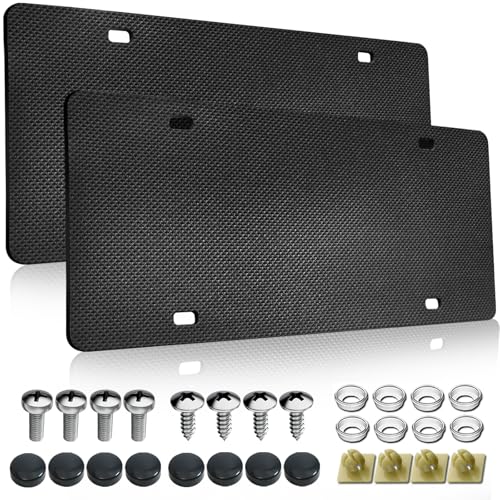
This two-pack uses 4 mm thickened EVA foam to damp vibration and form a barrier between the plate and vehicle body. Its listed installation process is peel, press the pad onto the back of the plate, and secure the plate with screws.
- Best for: Buyers who prefer an adhesive-backed foam pad with a stated thickness and simple installation sequence.
- Why it stands out: The instructions and 4 mm measurement make it easier to compare with products that do not specify thickness.
- Limitation: It is a foam backing pad, not a rigid rubber spacer that sets a precise gap.
Choose this if you want a continuous cushioning layer. For a particular screw-hole spacing or stand-off distance, measure first and consider a dimensioned ring spacer instead.
uxcell Thin Rubber Spacer Rings

The uxcell set includes 16 hollow rubber rings measuring 1 inch in outer diameter, 1/4 inch in inner diameter, and 1/8 inch in height. The listing describes them as vibration- and sound-insulating spacers with a center hole for installation.
- Best for: Buyers who need thin, dimension-specific rings and can confirm that the inner and outer diameters suit their mounting arrangement.
- Why it was selected: Its measurements are explicit, which is useful when choosing a spacer for a defined gap or fastener.
- Limitation: These are general-purpose rings, not a license-plate-specific backing pad; check fit and placement before use.
Choose this for a low-profile ring-style spacer. Avoid it if you need a large sheet of cushioning material behind the plate.
Aujen Silicone License Plate Frame

This one-pack frame is made from flexible silicone and is listed for U.S. license plates. The product description says the soft surface helps prevent scratches and rattles, while three drainage holes allow water to escape.
- Best for: Drivers who want a frame-based alternative that cushions around the plate rather than fitting separate spacers behind it.
- Why it was selected: The flexible material directly addresses rattling and surface contact, while the drainage openings are a stated design feature.
- Limitation: A frame is not a replacement for a precisely sized spacer when a specific gap or mounting position is required.
Choose this if a soft frame suits your setup. Check local plate visibility requirements and the frame’s coverage before installation.
Buying Guide: How to Choose a License Plate Spacer
Do you need bumpers, rings, or a backing pad?
Choose bumper-style pieces when you need a few small contact points. Ring spacers are better when a fastener passes through the center and you need a measured thickness. A foam backing pad provides wider coverage to separate much of the plate from the vehicle surface. A silicone frame cushions around the plate but does not create the same kind of stand-off as a ring.
Which measurements should you check?
For ring spacers, compare outer diameter, inner diameter, and thickness with the available mounting area and hardware. For bumpers, verify the hole size. For foam pads and frames, compare the product’s shape and coverage with your plate and mounting surface. The listed products do not provide every measurement, so do not assume a universal fit.
Is noise reduction or a defined gap the priority?
Foam pads are a practical choice when the goal is to cushion a broad contact area and reduce vibration. A rubber ring or bumper is more appropriate when you need a discrete spacer or contact point. If the plate is loose, inspect its fasteners as well; cushioning material alone may not correct a loose mounting connection.
Frequently Asked Questions
What does a license plate rubber spacer do?
It creates cushioning or separation between a license plate and its mounting surface. Depending on its shape and placement, it may help limit vibration, rattling, or surface contact.
Are foam pads the same as rubber spacers?
No. Foam pads generally cover a wider area and provide a soft backing. Rubber spacers are often individual rings or bumpers with defined dimensions.
How do I choose the right spacer size?
Measure the mounting hole, fastener, available surface, and desired thickness. Match those measurements to the product listing rather than relying on the term “universal.”
Can a license plate frame stop rattling?
A flexible frame may cushion the plate’s edges and help reduce contact noise. It may not solve movement caused by loose fasteners or provide a specific gap behind the plate.
Should I choose an adhesive pad or a screw-mounted spacer?
Choose based on the installation style and the area that needs cushioning. Adhesive pads cover more of the plate back, while screw-mounted rings or bumpers provide localized support.