Whether you’re a DIY enthusiast or a professional mechanic, choosing the right hydraulic lifting system is essential for safe, efficient vehicle work. This guide highlights five top options that cover a range of needs—from portable floor jacks to full 2-post lifts and heavy-duty porta power kits. Each product is evaluated for lifting range, load capacity, safety features, and portability to help you select a solution that fits your garage space and projects.
| Product | Capacity | Type |
|---|---|---|
| Tonda Floor Jack, 2 Ton | 2 tons (3,800 lb) | Portable Floor Jack |
| Tonda Floor Jack, Low Profile | 2 tons | Low-Profile Floor Jack |
| Amazon Basics Hydraulic Floor Jack | 2.2 Short Tons / 2 Metric Tons | Hydraulic Floor Jack |
| KATOOL 2-Post Lift | 10,000 lbs | 2-Post Lift |
| 20 Ton Porta Power Kit | 20 Tons | Porte Power Jack Kit |
The following sections explore each option in detail, focusing on how it serves different vehicle types, shop layouts, and repair tasks. All sections stay objective and provide practical considerations to help you decide which hydraulic system best suits your workflow.
Tonda Floor Jack, 2 Ton – Portable Car Jack

The Tonda Floor Jack with a 2-ton (3,800 lb) capacity provides a compact, mobile lifting solution suitable for most cars. Its minimum lifting height of 4.9 inches and maximum of 11.8 inches cover common maintenance tasks like tire rotations and underbody access. A built-in safety bypass valve helps prevent overloading, supporting safer operation. Large steel casters and 360-degree swivel casters improve maneuverability in tight garages, while a lightweight design aids transport between workstations.
Tonda Low Profile Floor Jack – Rapid Lift
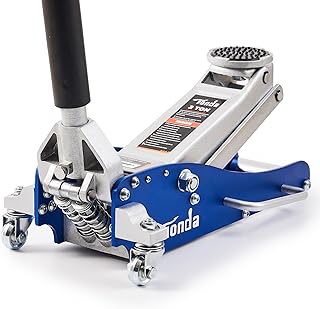
This low-profile 2-ton hydraulic jack is designed for vehicles with a low undercarriage. Its lifting range stretches from 3.35 inches to 13.98 inches, enabling easier access underneath sports cars, sedans, and some SUVs. The dual-pump system accelerates height attainment, reducing downtime during maintenance. A protective rubber saddle aligns with side seams to prevent frame damage and preserve painted or coated surfaces during lifting.
Amazon Basics Hydraulic Floor Jack – 2.2 Short Tons

The Amazon Basics jack offers a robust 2.2 short tons (2000 kg) capacity with a versatile lift range from 5.3 to 13.4 inches. It includes overload protection to prevent unsafe lifting and a slow-release mechanism for controlled lowering. This model emphasizes reliability and straightforward operation, making it a widely used option for standard passenger vehicles and light-duty tasks in busy garages.
KATOOL 2-Post Lift – 10,000 lbs

The KATOOL 2-Post Lift is built for heavier workloads, boasting a 10,000-pound capacity and ample 70.75 inches of lifting height with 110.25 inches of overall clearance. This lift is designed to provide superior undercarriage access, making it a solid option for taller vehicles, trucks, or more involved repairs. It carries CE certification and emphasizes safety through engineered design and load testing, appealing to professional shops and serious hobbyists with larger needs.
20 Ton Porta Power Hydraulic Jack Kit

The 20-ton porta power kit expands capabilities beyond vehicle lifting to include pushing, pulling, bending, spreading, and frame alignment. This versatile system is designed for auto body repair, truck work, and heavy equipment maintenance. The kit typically comes with extension tubes, saddles, wedges, and connectors—providing a complete solution for frame straightening and structural repairs in workshop environments.
Buying Guide
- Capacity and vehicle type: Match the lifting or pushing capacity to the heaviest vehicles you service. Light cars benefit from portable floor jacks, while trucks and SUVs may require higher-capacity lifts or porta power systems.
- Lift range and clearance: Ensure the minimum height allows access to jack points on current vehicles, and the maximum height provides sufficient clearance for undercarriage work or wheel removal.
- Safety features: Look for automatic overload protection, a slow-release mechanism, and a reliable bypass or bleed system. For lifts, verify compliance with safety standards and proper anchoring requirements.
- Portability vs. permanence: Portable jacks suit small garages or frequent reconfiguration, whereas fixed or semi-fixed lifts are advantageous for a dedicated workspace.
- Build quality and materials: Steel and high-grade components increase durability, though some low-profile units use aluminum for lighter weight. Consider corrosion resistance and saddle design to protect vehicle finishes.
- Maintenance and serviceability: Check availability of replacement parts, seals, and service manuals. A model with easy-replace components reduces downtime.
- Warranty and support: A robust warranty and responsive customer support help address potential hardware failures or safety concerns over time.
- Cost of ownership: Factor in not just the initial price, but potential accessories, extensions, and the need for additional equipment like base stands or alignment tools.
- Shop compatibility: Assess your ceiling height, floor condition, and space. Some lifts require dedicated anchoring and reinforced flooring; portable jacks minimize space constraints.
- Usage scenarios: Consider whether you primarily perform tire changes, oil services, or heavy frame work. Align your choice with typical tasks to maximize efficiency and safety.
Across these options, the right hydraulic system balances capacity, lift range, and safety with practical garage constraints. For simple tire changes or routine maintenance on most cars, a 2-ton floor jack with quick lift and a solid saddle is often sufficient. For taller vehicles or more demanding repairs, higher-capacity lifts or porta power kits provide greater versatility and undercarriage access. Always follow manufacturer instructions and use compatible stands or supports for added stability during service.