The best GPS race car lap timer helps drivers measure laps, accelerations, and track performance with precision. This guide targets enthusiasts seeking reliable data for night-and-day practice on road courses or drag strips. Top picks are suited for weekend racers, track-day enthusiasts, and professional teams looking for real-time feedback, easy track libraries, and robust data logging.
Summary of chosen products
| Product | Best For | Key Benefit |
|---|---|---|
| RaceBox Mini GPS Based Performance Meter Box 25Hz | Track days, casual racers | Very high GPS refresh rate for precise lap timing |
| RaceBox 10Hz GPS Official Based Meter Box | Serious track enthusiasts | Real-time lap data with multiple drag and lap metrics |
| CORSARO-II R GPS Lap Timer | Pro-level data analysis | Predictive timing and large track library |
| CORSARO-II PRO GPS Lap Timer | Advanced data logging | Color screen with advanced library and splits |
| Stealth GPS-5 Lap Timer | Compact installs, track mapping | Triple-constellation GPS with built-in mapping |
RaceBox Mini GPS Based Performance Meter Box 25Hz

The RaceBox Mini uses a 25Hz GPS module to deliver precise lap timing and performance data. Best for drivers who want fast, repeatable lap results and quick checks after each session. It records 0-100 km/h acceleration and ¼ mile times, then presents results via a mobile app for easy analysis. This model excels when high-frequency GPS data improves the fidelity of lap splits and sector times, making it ideal for track days and amateur competition.
Who this is best for: casual racers and track-day enthusiasts who want a compact, high-precision timer with a broad track library and easy app-based analysis.
Why selected: 25Hz refresh provides smoother, more accurate lap tracking than standard 5–10Hz devices, reducing timing jitter on fast laps. The device pairs with a mobile app for on-the-go analysis and quick sharing of results.
Caution: The device relies on GPS signals; performance can vary with poor satellite visibility or heavy cloud cover and may require a clear view of the sky.
RaceBox 10Hz GPS Official Based Performance Meter Box

The RaceBox model with 10Hz GPS offers an advanced toolkit for lap timing and drag performance measurement. It supports real-time lap data, quick session analysis, and a flexible drag meter with configurable modes for speed, distance, and predictions. This is a strong option for drivers who want precise timing without sacrificing a broad feature set or app integration.
Who this is best for: serious track enthusiasts seeking immediate feedback during sessions and the ability to perform in-depth analysis after each run.
Why selected: Real-time lap performance and fast data updates help drivers identify improvement areas during practice. The 4-mode drag meter provides deeper insight into acceleration and braking behavior.
Caution: Some users may prefer a larger display for on-bike use or pedestal mounting; consider installation needs for your vehicle setup.
CORSARO-II R GPS Lap Timer and Data Recorder
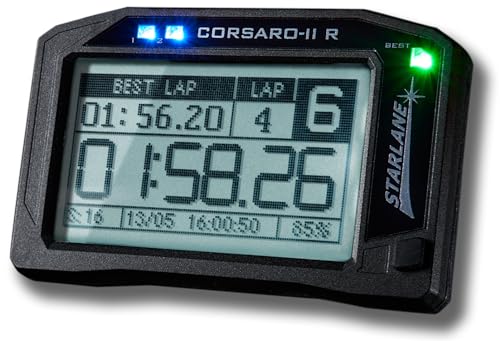
The Corsaro-II R delivers predictive lap timing and an integrated library with over 1000 tracks, enabling quick recognition of current tracks and automatic timing behavior. It supports trajectory data and splits, offering a robust set of features for drivers who want forward-looking lap time insights and a trusted track database.
Who this is best for: advanced racers and data-driven teams that rely on predictive timing and a wide track library for consistent practice sessions.
Why selected: Predictive timing helps anticipate lap performance, aiding strategy during a session. The extensive track library reduces setup time and ensures accurate recognition across venues.
Caution: Some users may find the device dense with features; ensure you have a clear workflow to capitalize on predictive timing and library options.
Stealth GPS-5 Lap Timer with Track Mapping

The Stealth GPS-5 is a compact lap timer featuring a large, high-contrast display for readability. It includes a built-in library with over 1,000 tracks and automatic track recognition. Trajectory acquisition is an option for vehicles, and the unit can be expanded with wireless modules for additional data logging and vehicle data capture.
Who this is best for: riders and drivers who need a compact, easy-to-install timer with strong mapping and a broad track library.
Why selected: The compact form factor makes it ideal for smaller vehicles or discreet installations without sacrificing important data features like track mapping and trajectory data.
Caution: Readiness for optional wireless modules may depend on your vehicle’s data needs and installed systems; confirm compatibility before purchase.
PGEAR 20Hz GPS P610 Based Performance Meter Box

The PGEAR P610-based system features 20Hz GPS for higher-fidelity timing and a mobile app for lap timer and drag meter functionality. It offers a racing accelerometer and multiple modes for measuring speed, distance, and performance, giving drivers a reliable toolkit for on-track data capture.
Who this is best for: enthusiasts who want elevated GPS frequency and a straightforward app-based workflow to review laps and accelerations.
Why selected: The 20Hz GPS provides smoother lap timing under aggressive driving, making it a solid mid-to-high-end option for serious coaching and practice sessions.
Caution: Data interpretation may require familiarity with the app’s analytics to maximize the value of the 20Hz data stream.
Buying Guide
What should you consider when choosing a GPS lap timer?
- GPS Refresh Rate: Higher Hz (e.g., 20–25Hz) yields smoother, more precise lap splits, especially on fast circuits.
- Track Library and Recognition: A large built-in library reduces setup time and ensures automatic recognition of tracks during sessions.
- Data Presentation: Look for devices with readable displays or robust app dashboards for real-time and post-session analysis.
- Data Logging and Export: Prefer units that log trajectory, speeds, and splits with export options for analysis in third-party software.
- Form Factor and Installation: Consider whether you need a compact, easy-to-mount unit or a larger display with detailed readouts.
- Connectivity: Bluetooth, Wi-Fi, or mobile app integration can influence how you review data and share results with teammates.
- Future Upgrades: Some models support optional modules or firmware updates that expand capabilities over time.
How to compare models?
- Compare GPS frequency (Hz) and how it affects timing precision for your typical lap speed.
- Check for predictive vs. static timing features and determine which aligns with your racing style.
- Evaluate the size and readability of the display, especially if you need quick glances on track.
- Assess the availability of a track library and automatic track recognition to minimize setup on new venues.
- Consider the ecosystem: app reliability, data formats, and whether you can share results with teammates or coaches.
Which timer is best for you?
- If you want the ultimate in precision and a broad round-up of features for both laps and drags, choose a 25Hz or 20Hz model with a large track library.
- For professional-level data with predictive timing, prefer Corsaro-II models featuring extensive libraries and trajectory data.
- If you need a compact, discreet unit with strong mapping, Stealth GPS-5 offers a solid balance of form and function.
FAQ
- What is a GPS lap timer used for? Answer: It records lap times, speeds, accelerations, and trajectories to help improve performance on tracks and drag strips.
- Do GPS lap timers require a constant signal? Answer: They perform best with a clear satellite view; obstructions can affect accuracy.
- Can I compare sessions across different tracks? Answer: Yes, most devices include a library and export options to compare laps on various venues.
- Is a higher Hz GPS always better? Answer: Generally yes for precision, but consider installation, battery life, and data needs.
- Are there any risks with using a GPS timer in a racing environment? Answer: Ensure the device is securely mounted and does not interfere with vehicle controls or safety equipment.