The best gas tank with wheels depends on how much fuel you need to move and how you plan to dispense it. The Scepter 14-gallon caddy offers gravity and manual siphon modes, while the VEVOR provides the largest stated capacity in this selection at 16 gallons. The PAMBEE is a practical choice for buyers who want a long hose and a stated siphon flow rate; Garvee options add features such as dual shut-off valves or a reinforced hose.
| Product | Capacity | Standout feature | Best for |
|---|---|---|---|
| Scepter Flo ’N Go | 14 gallons | Gravity or manual siphon modes | Flexible dispensing |
| VEVOR Fuel Caddy | 16 gallons | Rubber wheels and metal wire hose | Higher capacity |
| PAMBEE Fuel Caddy | 15 gallons | 10-foot hose and stated 3 GPM siphon flow | Long-reach refueling |
| Garvee Fuel Caddy | 15 gallons | Manual pump and 10-foot hose | Controlled transfer |
| Garvee Gas Caddy | 15 gallons | Two operating modes | Flexible dispensing |
Scepter Flo ’N Go 14-Gallon Fuel Caddy

The Scepter Flo ’N Go holds 14 gallons and uses a high-density polyethylene tank designed to resist corrosion and denting. Its six-inch wheels and heavy-duty top handle help move the caddy across rough ground. It supports two dispensing methods: gravity flow when elevated above the receiving tank, or manual pump-and-siphon operation when it is level with or below the tank.
Best for: Buyers who want the option to use gravity flow or a hand pump for farm, marine, lawn, and recreational equipment. The listed siphon-mode flow rate is 2.0 gallons per minute.
Limitation: At 14 gallons, it has less capacity than the 15- and 16-gallon options here. Manual siphoning also requires continuous operation of the hand pump.
VEVOR 16-Gallon Fuel Caddy

VEVOR’s 16-gallon tank is the highest-capacity option in this group. The product listing says it can hold gasoline, diesel, and machine oil. Six-inch rubber wheels are described as suitable for concrete, wood, dirt, and tile. Its metal wire hose is designed to resist bending and collapsing during use.
Best for: Buyers who prioritize capacity and want a hose described as more resistant to bending than a conventional rubber hose. The listing gives a transfer rate of 7.8 liters per minute.
Limitation: This is the largest listed capacity, so consider the weight of a filled tank and whether you can maneuver it safely in your storage and fueling areas.
PAMBEE 15-Gallon Caddy With 10-Foot Hose
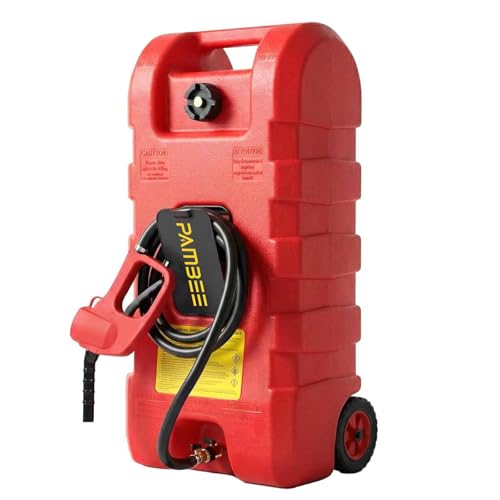
This PAMBEE caddy holds up to 15 gallons and has six-inch wheels and a top handle for transport. Its high-density polyethylene tank and nozzle are described as rust-proof, and the 10-foot automotive-grade rubber hose comes with a holder for storage. The caddy supports both siphon and gravity-drive refueling.
Best for: Buyers who need hose reach for equipment that is not right beside the tank. The stated siphon-mode flow rate is up to 3 gallons per minute, though the listing notes that pumping speed affects flow.
Limitation: The stated siphon rate depends on how quickly the manual pump is operated, so it should not be treated as a guaranteed constant transfer speed.
Garvee 15-Gallon Caddy With Manual Pump

This Garvee model pairs a 15-gallon tank with a manual transfer pump, a 10-foot reinforced hose, and a 360-degree rotating nozzle. The listing describes industrial-grade HDPE construction, reinforced walls, dual shut-off valves, vapor-tight seals, a child-resistant cap, and anti-static grounding. Its T-grip handle is intended to support controlled manual pumping.
Best for: Buyers seeking a 15-gallon wheeled caddy with a long hose and multiple listed storage and transfer features for equipment such as mowers, cars, boats, and farm machinery.
Limitation: This model relies on a manual pump; choose another option if you specifically require a stated gravity-feed mode or a published transfer rate.
Garvee 15-Gallon Caddy With Two Modes

This Garvee 15-gallon caddy is made from one-piece industrial-grade HDPE, according to its listing. It offers two operating modes: tilting the tank for fuel delivery or using the manual pump and D-shaped handle to build internal pressure. Other listed features include a reinforced hose, 360-degree rotating nozzle, dual shut-off valves, a sealing washer, and a removable inlet filter.
Best for: Buyers who want a choice between tilting the tank and manually pumping, along with a rotating nozzle for directed refueling.
Limitation: The instructions say to open the air valve before refueling and close it afterward. Buyers should follow the included operating directions to support proper flow and storage.
Buying Guide: How To Choose A Gas Tank With Wheels
How much capacity do you need?
Compare the tank capacity with your equipment’s fuel needs and how often you want to refill the caddy. The options here range from 14 to 16 gallons. A larger tank can reduce refill trips, but a full tank is heavier to move. Check whether the filled unit can be maneuvered through your route and stored in your available space.
Do you need a pump, gravity flow, or both?
Gravity dispensing requires the caddy to be positioned above the receiving tank. Manual pump or siphon operation may be more suitable when the caddy remains on the ground, but it requires active pumping. The Scepter and PAMBEE listings describe both gravity and siphon modes. Check the product instructions for the required positioning and procedure.
What hose and wheel features matter?
A longer hose can help reach equipment that cannot be parked beside the caddy; the PAMBEE and one Garvee model list 10-foot hoses. Hose materials and construction vary, including rubber and reinforced or metal-wire designs. Wheel size and material also affect how the caddy may roll across a particular surface. Match those details to your yard, shop, or job site rather than assuming all wheels perform alike.
Which safety details should you check?
Review the manufacturer’s instructions for approved fuels, storage, transport, and dispensing. Compare listed features such as shut-off valves, seals, caps, and grounding, but do not treat a feature description as a substitute for safe handling. Keep fuel away from ignition sources, avoid spills, and verify that the tank is intended for the fuel you plan to store.
Frequently Asked Questions
What is a gas tank with wheels called?
It is commonly called a fuel caddy or gas caddy. It combines a portable fuel tank with wheels and a handle to make moving stored fuel easier.
Can a wheeled gas tank dispense fuel without pumping?
Some models offer gravity flow when elevated above the receiving tank. Other models require manual pumping, and some list both methods. Check the specific product instructions.
Which listed caddy has the largest capacity?
The VEVOR fuel caddy has the largest listed capacity in this selection at 16 gallons.
Does a longer hose make refueling faster?
Not necessarily. Hose length affects reach, while transfer speed depends on the pump or gravity setup and the product’s design. The PAMBEE listing notes that manual pumping speed affects its siphon flow.
Can these caddies be used for diesel?
Some listings specifically name diesel as a supported fuel. Confirm the manufacturer’s stated fuel compatibility for the exact model before filling it.