Answering the search for reliable gas tank sealers, this guide highlights five proven products for DIY repairs and sealing. The best options suit different users: do-it-yourselfers needing quick fixes, hobbyists sealing small leaks, professionals seeking complete kit solutions, and riders with metal or composite tanks. The table below summarizes the five recommended products and their core strengths to help narrow choices quickly.
| Product | Best For | Key Benefit |
|---|---|---|
| J-B Weld 8217 TankWeld | Metal tanks and repairs | Fast-setting, steel-reinforced epoxy putty |
| RED KOTE Tank Sealer (1 Qt) | All fuel tanks needing corrosion protection | Gasoline and ethanol resistant polymer coating |
| KBS Coatings 52000 Cycle Tank Sealer Kit | Thorough kit for rusted tanks | Complete system with cleaners, rust remover, and sealer |
| J-B Weld 2110 Metal Fuel Tank Repair Kit | Permanent leaks with no tank removal | Cold-weld epoxy with fiberglass cloth for durable repairs |
| POR-15 Fuel Tank Sealer (16 oz) | Long-lasting rust and leak prevention | Non-porous, flexible film, fuel resistant |
J-B Weld 8217 TankWeld Gas Tank Repair

The J-B Weld 8217 TankWeld is a hand-mixable, steel-reinforced epoxy putty designed for quick repairs on metal tanks. Best for DIYers repairing small dents, pinholes, or cracks in gas tanks, radiators, and other metal vessels. It sets in 5 minutes and cures to a dark grey metal-like finish with a tensile strength around 900 PSI, offering a dependable seal for temporary or semi-permanent fixes. A potential limitation is its reliance on proper surface prep; adhesion improves with clean, dry metal.
RED KOTE Fuel Tank Sealer

This 1-quart tank sealer by KCINT is a polymer coating designed to seal leaking fuel tanks. It’s gasoline, diesel, and ethanol tolerant, making it flexible for modern fuels. Best for tanks with visible leaks and minor corrosion, it forms a barrier that resists pinholes and seepage when the directions are followed closely. A limitation is that proper prep and coating thickness are crucial; incomplete application can lead to incomplete sealing.
KBS Coatings 52000 Cycle Tank Sealer Kit

The KBS 52000 Cycle Tank Sealer Kit provides a complete three-step system, including degreaser, rust remover, metal etch, and the tank sealer. It’s designed to permanently seal rust and pinholes on metal tanks and is compatible with modern fuels, including ethanol blends. Best for users who want an all-in-one solution that minimizes extra purchases. A caution is that the kit is designed for thorough prep; skipping steps may compromise durability.
KBS Coatings 5200 Gold Standard Tank Sealer

The KBS 5200 Gold Standard Tank Sealer offers a single-pack option focused on forming a tough, non-porous barrier against fuel exposure. It’s intended for permanently sealing pinholes and weld seams while maintaining flexibility to handle thermal expansion and contraction. Best for users seeking a streamlined, durable coating with long-term resistance to fuels. A potential limitation is that it is a smaller package compared to full kit options, which may require sizing to tank capacity.
J-B Weld 2110 Metal Fuel Tank Repair Kit

The J-B Weld 2110 Repair Kit delivers a complete repair solution with epoxy putty, fiberglass cloth, sandpaper, and applicator. It’s designed for permanent fixes without removing the tank, suitable for holes up to 3/8″ and cracks up to 4″ long. Best for professional-grade, field repairs by DIY enthusiasts who want a reliable, cold-weld alternative. A caution is that surface prep and cure time influence durability; ensure clean surfaces and correct mixing ratios.
KBS Coatings 5300 Gold Standard Tank Sealer

The KBS 5300 Gold Standard Tank Sealer provides a robust option focused on fuel compatibility and long-term sealing. It is impervious to most fuels and alcohol additives while remaining flexible to accommodate tank movement. Best for heavy-use vehicles or older tanks with pinholes and seams. A limitation to note is the need to confirm fuel compatibility with your specific blend before application.
Eastwood Steel Aluminum Fiberglass Gas Diesel Tank Sealer Kit

Eastwood’s sealer kit targets steel, aluminum, and some fiberglass tanks with pinhole leaks. One pint covers tanks up to 12 gallons. Best for mixed-material tanks where a flexible, intermediate solution is needed. Not recommended for fuels with more than 10% ethanol, which can affect some coatings. A limitation is ethanol sensitivity in certain blends; verify fuel type before application.
POR-15 Fuel Tank Sealer
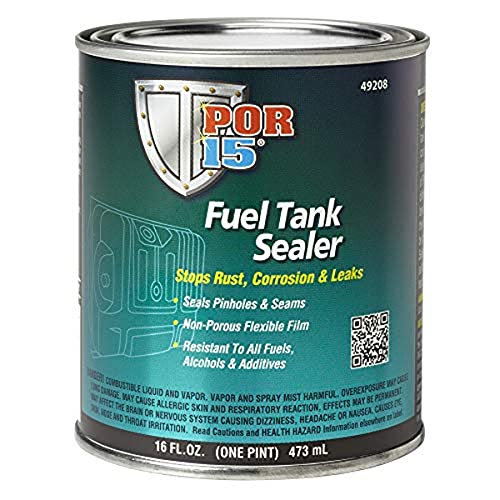
POR-15 Fuel Tank Sealer is designed to stop rust, corrosion, and leaks with a non-porous, flexible film. It’s particularly noted for its rust-preventive properties and compatibility with a wide range of fuels. Best for long-term protection in tanks with significant corrosion history. A caution is that prep is essential; all fuel must be drained and the tank cleaned before sealing for a successful finish.
Buying Guide: How To Choose The Right Gas Tank Sealer Epoxy
- What is the tank made of? Some sealers are better for steel, others for aluminum or mixed materials. Pick a product compatible with the tank’s metal or composite.
- Do you need a kit or a single-coat sealer? Complete kits simplify preparation and application, while single-coat sealers are quicker for minor repairs.
- Fuel compatibility matters. Check if the sealer tolerates ethanol blends (E10, E15, E85) and modern gasoline additives.
- Surface condition. For rusted tanks, rust removers and etching steps in a kit can improve adhesion and longevity.
- Application environment. Consider cure times, temperature requirements, and whether removal of the tank is feasible or required for best results.
- Long-term durability. Evaluate whether the coating remains flexible to handle expansion, contraction, and vibrations over time.
Frequently Asked Questions
- Do tank sealers stop rust permanently? Some products provide long-term rust resistance, but regular inspection is recommended for signs of leakage or corrosion.
- Can I seal a completely full tank? Most sealers require draining and cleaning the tank; follow the product’s prep instructions closely for best results.
- Is it safe to seal a tank without removing it from the vehicle? Some kits enable in-situ repairs, but many entail tank removal for thorough prep and coating.
- Will ethanol fuel blends affect sealer performance? Some formulas are ethanol-compatible; verify compatibility with your fuel type before applying.
- How long before the tank can be used after sealing? Cure time varies; follow the product’s specified curing period and conditions to achieve full hardness.
- Which product is best for a rusted tank? Kits that include rust removal and etching tend to deliver more durable results on rusted tanks.