If you’re looking to stop rust, leaks, and corrosion in motorcycle fuel tanks, these liners and sealers are designed to protect metal and fiberglass interiors. This guide highlights five top options, who they’re best for, and how they differ. Ideal buyers include classic bike owners, off-road riders, and anyone maintaining older tanks with visible rust or pinhole leaks. A quick summary table follows the intro to help you compare key details at a glance.
| Product | Best For | What It Does |
|---|---|---|
| Kreem 19-103 Fuel Tank Liner Combo Pack | Owners seeking a complete 3-step protection | Seals and protects tank interior, prevents rust and leaks |
| RED KOTE Fuel Tank Sealer (KCINT) | Leaking tanks and small cracks | Polymer coating resistant to fuels; seals leaks up to about 14 gallons |
| Kreem Tank Liner Pint | New or refurbished tanks | Creates a tank-within-a-tank protective lining |
| Speedway Motors Lawn Mower & Motorcycle Tank Liner Kit | DIY protect-and-seal for metal tanks | Cleans, seals, and protects |
| Kreem Fuel Tank Liner Combo-Pak 1210 | Versatile protection for metal and fiberglass tanks | Rapid-set formula with durable elastomer coating |
Kreem Products 19-103 Fuel Tank Liner Combo Pack

The Kreem 19-103 combo pack is a 3-step system designed to seal and protect motorcycle fuel tanks. It’s best for riders who want a complete, time-tested method to prevent rust, corrosion, and leaks. The kit targets older or mildly corroded tanks where a full interior coating is advantageous. Selection is ideal for riders who value a guided, multi-step process and a robust interior seal.
Caution: Follow the three-step instructions closely to achieve a proper seal and avoid incomplete coverage on complex tank shapes.
RED KOTE Fuel Tank Sealer (1 Qt)

This KCINT sealer is a polymer coating formulated to resist gasoline, diesel, and additives. It is positioned for addressing leaks in metal tanks up to about 14 gallons. It’s best for owners who need a straightforward sealing solution to fix small to mid-sized leaks with a single-application approach, especially when rust is present due to condensation.
Choose this if you want a dedicated tank sealer that works across common fuel types and aims to stop leaks quickly with proper surface preparation.
Limitation: Proper surface prep and adherence to directions are essential for an effective seal; failure to follow steps may reduce performance.
Kreem Tank Liner Pint

The Kreem pint is described as creating a tank-within-a-tank, forming a tough interior lining against rust and corrosion. It’s best for small- to medium-tank capacities or repurposing older tanks where a new interior lining is desired. It’s especially suitable for users who want a compact, lower-volume kit that still delivers durable protection.
Best for smaller tanks or DIY projects where a precise, localized internal coating is needed.
Lawn Mower & Motorcycle Fuel Tank Liner Kit
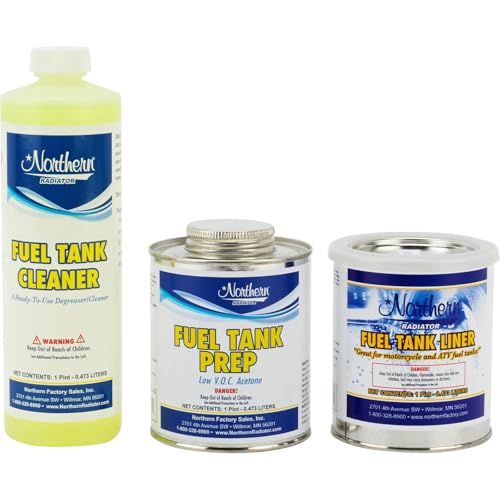
This liner kit from Speedway Motors is positioned for both lawn mower and motorcycle tanks, offering cleaning, sealing, and protective action in one package. It’s best for DIY enthusiasts who want a versatile kit that can handle multiple tank types, with straightforward use and broad compatibility with common metals.
Best for mixed-use owners or hobbyists who service both lawn equipment and motorcycles in a single project.
Limitation: Universal kits may require more careful compatibility checks with unusual tank geometries.
Kreem Fuel Tank Liner Combo-Pak 1210

The Kreem 1210 combo-pak offers versatile protection for both metal and fiberglass tanks. It’s compatible with gasoline, gasohol, and diesel fuels, featuring a rapid-set formulation that resists corrosion, stops leaks from hairline cracks, and provides a durable elastomer coating. The kit includes an additive to support high visibility for interior inspection thanks to titanium dioxide.
Best for owners with mixed tank materials or those needing a quick, durable cure with easier inspection of interior conditions.
Limitation: The rapid-set formula may require precise timing on mixed tank sizes to ensure complete cure.
Buying Guide: Key Purchase Considerations
- Tank material: Metal vs fiberglass tanks may respond differently to coatings. If your tank is fiberglass or a composite, verify compatibility with the product’s coating.
- Tank condition: For tanks with visible rust or pinholes, consider products designed for leak sealing first, then follow with a liner for long-term protection.
- Volume and capacity: Suited for different tank sizes; match the kit’s volume to your tank capacity (e.g., 1 quart for smaller tanks, multi-pack for larger or multiple tanks).
- Application complexity: Some options use a multi-step process; others are single-application sealers. Choose based on your comfort with DIY procedures.
- Fuel compatibility: Confirm that the liner or sealer is compatible with the fuels you use (gasoline, ethanol blends, diesel, additives).
- Inspection visibility: Some formulations include features (like titanium dioxide) to aid interior inspection post-application. Consider whether this is important for you.
- Drying and curing time: Plan for the required cure time to avoid fuel exposure during the process and ensure full cure before use.
FAQ
- Q: Do fuel tank liners stop all leaks immediately? A: They seal many small leaks when applied correctly, but larger structural failures may require tank replacement.
- Q: Can I use these products on a brand-new tank? A: Yes, some liners are suitable for new or refurbished tanks, but always follow the product’s guidance for new installations.
- Q: Will liners affect fuel additives or performance? A: Most products are designed to withstand common fuels; verify compatibility if you use specific additives.
- Q: How long does a liner take to cure? A: Cure times vary; follow the manufacturer’s instructions for the specific product and environmental conditions.
- Q: Is professional installation recommended? A: For complex tanks or uncertain conditions, professional application can ensure proper surface prep and coating.
- Q: Can I remove a liner later? A: Most interior coatings are designed to be permanent or semi-permanent once cured; removal can be difficult.