The best fuel oil mixing bottle makes it easier to measure oil accurately before combining it with gasoline for a two-stroke engine. The Attwood bottle is a strong choice for boaters who want a wide mouth and a quart capacity; the Samorillo two-pack offers several ratio options and two bottles; and the Maxima Quick-2-Mix covers a broad range of ratios. The right pick depends on your equipment’s specified fuel-to-oil ratio, desired capacity, and how you plan to pour and store the mixture.
| Product | Best For | Standout Feature |
|---|---|---|
| Attwood Fuel and Oil Mixing Bottle | Boaters and straightforward measuring | Quart capacity and wide mouth |
| Showingo 1 Liter Mixing Bottle | Portable general-purpose mixing | Four common ratio markings |
| Sanbaiyi 1L Mixing Bottle | Compact storage and repeated use | Four ratios and reusable construction |
| Samorillo Wide-Mouth Two-Pack | Multiple tools or work locations | Six ratios and two bottles |
| Maxima Quick-2-Mix | Wide ratio range | Ratios from 24:1 to 100:1 |
Attwood Fuel and Oil Mixing Bottle
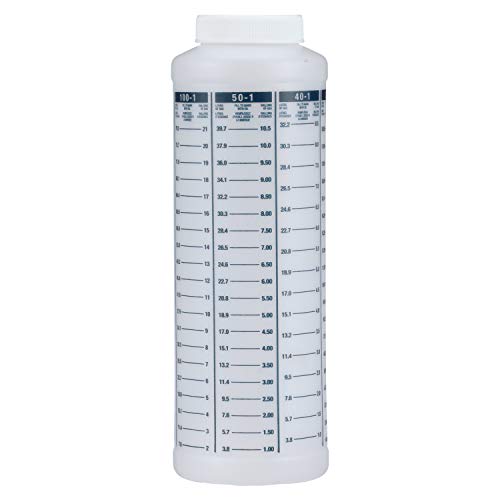
This quart-capacity bottle is best for buyers who want a straightforward measuring aid, particularly for preparing fuel for two-stroke marine engines. Its marked measurements help users gauge fuel-to-oil ratios, while the wide-mouth design is intended to make filling, pouring, and mixing more convenient.
Why it stands out: The larger capacity and wide opening suit users who value easier handling over a compact one-liter format. It can also reduce guesswork by providing visible measurement indicators.
Limitation: The listed features do not specify individual ratio markings, so check the bottle’s scale and your engine’s required ratio before use.
Showingo 1 Liter Mixing Bottle

Choose this reusable one-liter bottle if you need a compact container for common two-stroke equipment such as a lawnmower, brush cutter, or chainsaw. Its listed markings cover 50:1, 40:1, 32:1, and 25:1 ratios, making it useful for users whose equipment calls for one of those blends.
Why it stands out: The bottle combines portable capacity with four specified ratio options. Its reusable design is intended for repeated fuel-mixing tasks.
Limitation: Its listed ratio range does not include every possible two-stroke mix. Confirm that your equipment’s manual specifies one of the marked ratios.
Sanbaiyi Precision-Ratio Mixing Bottle

This Sanbaiyi bottle is best for buyers who want a one-liter, portable container with four clearly identified ratios: 50:1, 40:1, 32:1, and 25:1. The listed features describe its material as chemical- and oil-resistant and designed for repeated use. Its compact dimensions are listed as approximately 8.5 by 4.7 by 3.1 inches.
Why it stands out: The combination of four ratio markings, one-liter capacity, and compact size makes it a practical option for a workshop, truck, or job site.
Limitation: The stated ratio choices are limited to the four listed options, so it may not suit equipment requiring another blend.
Samorillo Wide-Mouth Mixing Bottle Two-Pack

The Samorillo set is best for buyers who want a spare bottle or need to keep mixing containers in separate locations. Each bottle holds up to 20 ounces (590 milliliters). The markings include six ratios—24:1, 32:1, 40:1, 50:1, 60:1, and 100:1—and measurements in ounces, milliliters, cubic centimeters, gallons, and liters.
Why it stands out: Two bottles, a wide mouth, and a comparatively broad set of ratio markings offer flexibility for different mixing tasks. The product listing also describes the scale as smudge-proof and the cap as double-turn and tight-locking.
Limitation: Each bottle’s 20-ounce capacity is smaller than the one-liter options, which may mean more frequent preparation for larger jobs.
Maxima Quick-2-Mix Bottle
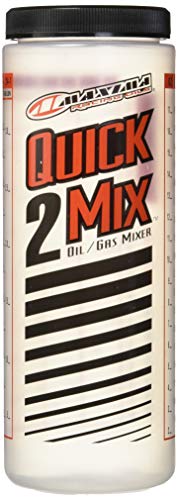
Choose the Maxima Quick-2-Mix if your priority is a broad range of ratio choices in one measuring bottle. Its 20-ounce capacity is calibrated for ratios from 24:1 to 100:1. The listed calibrations include ounces, cubic centimeters, gallons, and liters, allowing users to measure with several common units.
Why it stands out: The 24:1-to-100:1 range covers more ratio choices than the four-ratio bottles in this selection, making it useful when equipment requirements vary.
Limitation: At 20 ounces, it has less capacity than the quart and one-liter options. Check the markings carefully and use the ratio specified by the engine manufacturer.
Buying Guide: How to Choose a Fuel Oil Mixing Bottle
Which ratios does your equipment require?
Start with the engine or equipment manual, not the bottle’s most prominent marking. Two-stroke engines may require different fuel-to-oil ratios. Select a bottle with a clearly readable marking for the ratio you need. The Samorillo and Maxima options list broader ranges, while the Showingo and Sanbaiyi bottles list four specific ratios.
How much fuel do you usually prepare?
Consider the amount you typically mix. The Attwood bottle holds one quart, and the Showingo and Sanbaiyi bottles hold one liter. Samorillo and Maxima list 20-ounce capacities. Larger containers can suit bigger batches, while smaller bottles may be easier to carry and store.
Will you pour or transport the mixture?
A wide-mouth opening can make filling and pouring more convenient; Attwood and Samorillo specifically list wide-mouth designs. Samorillo also lists a tight-locking cap. Compare these handling features with where you mix fuel and whether you need to transport the prepared blend.
Are measurement units easy to read?
Look for markings that match your preferred units and are easy to distinguish. Several options list ratio-specific scales, while Samorillo and Maxima also specify multiple measurement units. Clear markings help reduce calculation steps, but they do not replace following the equipment’s required ratio.
Frequently Asked Questions
What is a fuel oil mixing bottle used for?
It measures oil and fuel in a specified proportion for two-stroke engines. The correct ratio depends on the equipment manufacturer’s instructions.
Can one bottle work for different two-stroke tools?
It can be used for different tools if its markings support each tool’s required ratio and the bottle is handled appropriately. Verify the ratio for every engine.
Is a larger mixing bottle always better?
No. Larger capacity can help with bigger batches, while a smaller bottle may be easier to carry or store. Choose based on your typical mixing amount and portability needs.
Should I choose the bottle with the most ratio markings?
Choose markings that include your equipment’s required ratio. A broader range can be useful when maintaining multiple tools, but the correct specific ratio matters most.