Answering the need for reliable paint thickness readings, these gauges help buyers verify coating uniformity, detect prior repairs, and support pre-purchase inspections. Best for used-car shoppers, detailers, and automotive inspectors who require fast, repeatable results on metal panels. The following five models stand out for accuracy, substrate detection, and ease of use across common car body materials.
| Product | Material Detection | Resolution | Range | Best For |
|---|---|---|---|---|
| CM-205FN (VVV-Group) | Fe / NFe automatic | 0.1 μm | 0–1500 μm | Mixed-metal bodies, quick checks |
| CM-224 Auto (VVV-Group) | Fe / NFe / Fe+Zn | 0.1 μm | 0–1500 μm | Car inspections with galvanized or zinc-coated panels |
| CM-224Pro (VVV-Group) | Fe / NFe / Zn | 0.01 mils | 0–59.1 mils | Professional, dealership and detailed comparison work |
| RDINSCOS Car Coating Thickness Meter | Fe / NFe | 0.1 μm | 0–1500 μm | Used-car checks with dual-substrate auto-detection |
| AstroAI Paint Thickness Gauge | Fe / NFe | 0.01 mils | 0–59.1 mils | Used-car buyers needing auto-detection and alarms |
Paint Thickness Gauge CM-205FN for Cars

The CM-205FN offers high-accuracy measurements with 0.1 μm resolution and automatic substrate detection between Fe and NFe. It is factory calibrated and ready to use after battery installation. This model is ideal for professionals performing pre-purchase checks, detailing, and quality control on painted metal panels such as doors, hoods, roofs, and fenders. It is best for buyers who need quick, automatic material recognition to minimize setup time, especially on vehicles with mixed metal bodies.
Best for: Professional inspectors and mobile appraisers who require fast, reliable readings with auto-detection. Better for: Vehicles with a combination of steel and aluminum panels. Choose this if: you want a straightforward, ready-to-use gauge with automatic Fe/NFe detection. Caution: The display reflects readings under backlighting; ambient lighting may affect visibility in very bright conditions.
Car Coating Thickness Meter – RDINSCOS
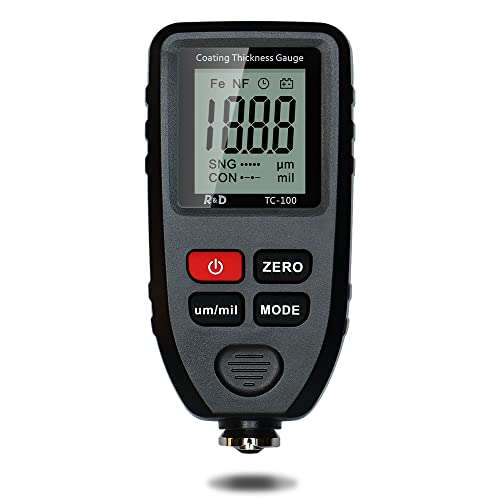
RDINSCOS emphasizes dual-technology auto-detection for steel and aluminum coatings, easing measurements on common automotive panels. It’s particularly suited for used-car buyers who want to verify uniformity on each panel and identify non-original surfaces. The device supports metal surfaces beyond cars, such as appliances and bike frames, making it a versatile option for multi-surface inspections. It is designed for metallic surfaces only, so non-metal substrates are outside its scope.
Best for: Used-car shoppers seeking a straightforward, auto-detecting gauge for steel and aluminum panels. Better for: Quick checks across multiple panels without manual substrate switching. Choose this if: you mainly inspect metallic vehicles and want automatic Fe/NFe detection. Caution: Designed primarily for metallic surfaces; not ideal for non-metal coatings.
CM-224 Auto – Digital Coating Thickness Meter (VVV-Group)

The CM-224 Auto extends the Fe/NFe/Fe+Zn substrate detection, helping identify replaced or non-original panels. Its 0.1 μm resolution and wide 0–1500 μm range support precise comparisons during professional car inspections, dealership evaluations, and pre-purchase checks. The gauge is ready to use with automatic substrate recognition, supporting instant readings on mixed-material vehicles. It’s a solid choice for professionals who need reliable data across different coating types.
Best for: Dealers and inspectors who encounter galvanized or zinc-coated panels. Better for: Mixed-material cars where auto-detection simplifies workflow. Choose this if: you want automatic detection across more substrate types. Caution: Some users may prefer higher resolution for detailed refinements, though it remains highly capable for automotive use.
YOWEXA Coating Thickness Gauge
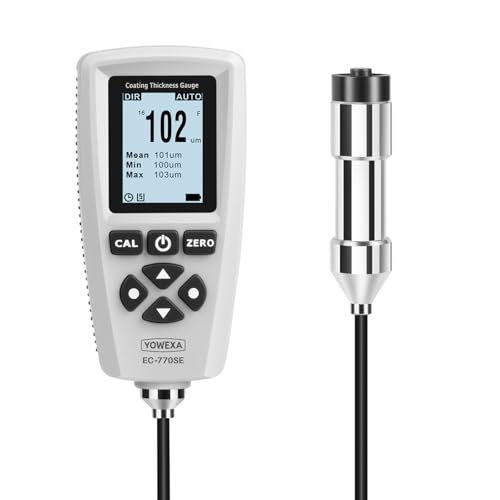
YOWEXA supports 0–2000 μm readings with ±2%+1 μm accuracy and offers both magnetic induction and eddy current testing to identify Fe or NFe substrates. An external probe helps measure hard-to-reach areas and curved surfaces. It stores up to 2000 readings and can export data via USB, supporting QC records and reporting. This model suits field inspectors and shop technicians who need robust data management and versatile measurement modes.
Best for: QC technicians and field inspectors who require data storage and versatile probing. Better for: Hard-to-reach panels and detailed reporting. Choose this if: you need multiple modes and external probing. Caution: The external probe adds size; ensure you have space to maneuver on tight panels.
AstroAI Paint Thickness Gauge
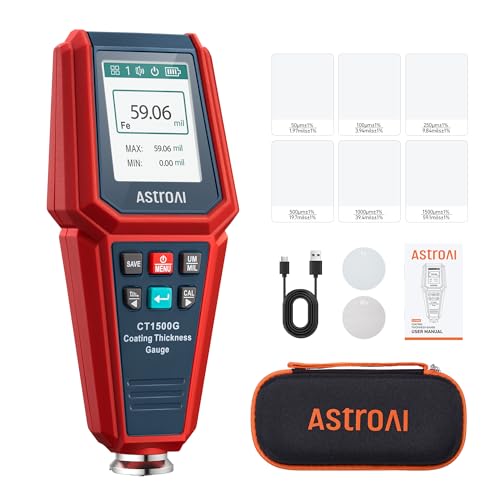
The AstroAI gauge emphasizes automatic detection of ferrous and non-ferrous substrates, delivering reliable measurements across magnetic and non-magnetic bases. It supports a wide coating range and multiple coating types, making it a practical option for used-car buyers who want to confirm uniformity across panels. The device is designed to aid identifying potential repair work by highlighting variations in thickness across the vehicle’s surface.
Best for: Used-car buyers seeking a balance of accuracy and user-friendly features. Better for: General automotive inspections without specialized hardware. Choose this if: you want a straightforward gauge with auto-detection and a limit alarm. Caution: It may provide less granular readings on extreme variations compared to higher-end models.
Buying Guide: Key Purchase Considerations
- Substrate detection: Do you need auto-detection for Fe/NFe or Zn? Models with multiple substrate profiles simplify use on modern vehicles with mixed materials.
- Resolution and range: Higher resolution (0.01 μm) helps detect subtle thickness differences; larger range (0–1500 μm or more) suits both factory coatings and refinishes.
- Ease of use: Factory calibration, backlit displays, and automatic calibration reduce setup time, especially for professionals and mobile inspectors.
- Data handling: Consider devices with data storage and USB export if you need to maintain test records or generate reports.
- Probe access: External or angled probes help measure curved or recessed panels; assess whether you need this flexibility for hard-to-reach areas.
- Intended buyer: For used-car shoppers, prioritize clear readings and auto-detection that reveal hidden repairs; dealers may favor higher-resolution models for precise comparisons.
- Durability and battery life: Look for devices with long battery life and robust construction, especially for field use and outdoor inspections.
FAQ
- What does coating thickness gauge measure on a car?
It measures the thickness of the paint or coating layer on metal panels to detect inconsistencies or past refinishes. - Why is automatic substrate detection important?
It ensures the correct measurement principle is applied for the material under test, improving accuracy on mixed-material vehicles. - Can these gauges detect hidden repairs?
Yes, by showing variations in thickness across panels that may indicate repainting or refinishing. - Is higher resolution always better?
Higher resolution allows finer distinctions but may not be necessary for general inspections; choose based on your reporting needs. - Do these devices require calibration?
Some models are factory calibrated and ready to use; others may offer automatic calibration or minimal setup. - What should I consider when buying for a used-car purchase?
Prioritize auto-detection, ease of use, data storage for records, and the ability to compare readings across multiple panels.