Whether you’re a weekend warrior, a fleet manager, or a daily commuter, a smart car battery charger makes maintenance effortless and safer. These devices automatically charge, monitor health, and protect against overcharge. The top picks here are designed for 12V batteries commonly found in cars, boats, and recreational vehicles, with support for AGM, GEL, and deep-cycle configurations. The best options balance fast charging, safety features, and automated repair modes. The list below highlights five models that suit different needs and budgets.
Summary table of selected products:
- TowerTop 2/10/25 Amp 12V Smart Charger — Best for multiple battery types and faster charging
- NOCO GENIUS1 — Best for compact, all-in-one maintenance on light-duty systems
- YONHAN 20A 12V/24V — Best for faster, winter-ready maintenance and repair
- NOCO GENIUS5 — Best for higher power in a compact package
- NOCO GENIUS10 — Best for higher-capacity, versatile charging with intelligent features
TowerTop 12V Smart Charger: Versatile Auto Charging and Maintenance

Best for: users needing flexible current settings for a range of battery sizes and chemistries. This charger offers 2A, 10A, 25A, and AUTO modes with a maximum 25A output, making it suitable for quickly charging a 100Ah battery and maintaining various 12V sealed lead-acid batteries.
Why selected: It supports AGM, STD, Gel, Wet, MF, EFB, calcium, and deep-cycle batteries, and includes auto desulfator and winter mode. It automatically detects battery status, begins charging within 30 seconds when needed, and preserves charge with a maintenance pulse after full charge. It even remembers the last settings after a power outage, enhancing reliability. However, high-current use may require a stable power source for optimal performance.
NOCO GENIUS1: Compact Auto Maintainer

Best for: small vehicles or motorcycles where space is limited and lightweight maintenance is preferred. This model combines charger, maintainer, trickle charger, and desulfator in one unit, with automatic temperature compensation for safe charging.
Why selected: It supports 6V and 12V lead-acid and lithium batteries and provides overcharge protection. The integrated thermal sensor helps prevent overheating and undercharging. A potential limitation is that its 1A rate may be slower for larger batteries during initial charging, making it less ideal for very large systems.
YONHAN 20A 12V/24V Battery Maintainer

Best for: owners needing faster charging and winter-ready maintenance across 12V and 24V systems. This charger supports 20A for 12V and 10A for 24V and covers a wide range of battery types including LiFePO4 and AGM.
Why selected: It features winter mode and smart control to adapt charging to temperature, plus multiple protections such as reverse polarity, overcurrent, and short-circuit protection. It can safely recover older batteries via a dedicated repair mode, though it cannot revive a completely dead battery. Users should ensure access to an outlet for operation.
NOCO GENIUS5: Mid-Range Power with Desulfator

Best for: users who want more charging power in a compact form factor for multiple battery types. This 5A unit increases charging capabilities while retaining smart features.
Why selected: It supports lead-acid and lithium batteries including AGM, Gel, SLA, VRLA, and LiFePO4. It includes temperature compensation and a desulfator function to help maintain battery health. It’s a balance between size and output, making it suitable for moderate battery needs. A limitation is that higher-power applications may benefit from a 10A or 25A unit for faster initial charging.
NOCO GENIUS10: High-Output Smart Charger
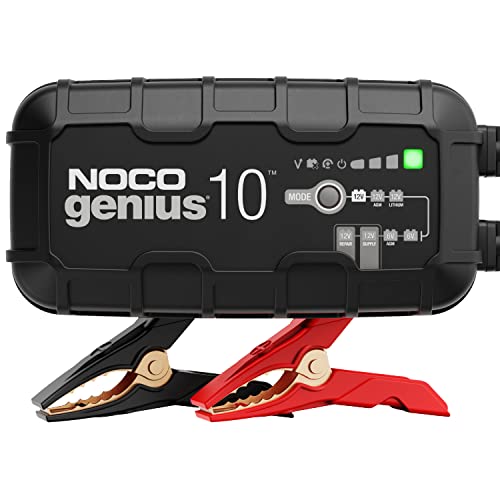
Best for: larger batteries or systems requiring frequent, high-speed charging with intelligent maintenance. The GENIUS10 pairs high power with advanced safety features, ideal for demanding automotive or marine setups.
Why selected: It offers 10A charging for faster replenishment and supports 6V/12V lead-acid and lithium batteries. Temperature compensation helps prevent overcharging in heat and undercharging in cold. It remains compact and compatible with a wide range of battery chemistries. A potential limitation is that very small batteries may not require its full capability, though it remains safe for such use.
Buying Guide: Smart Charger Essentials
- Battery type compatibility: Confirm the charger supports your battery chemistry (AGM, GEL, flooded, deep-cycle, or LiFePO4). Some models emphasize lead-acid, while others add LiFePO4 support. If you have mixed batteries, choose a model with broad compatibility.
- Voltage and current options: Look for 12V systems as standard. Higher current (6A–25A) speeds up charging for large batteries but may be unnecessary for small batteries. An AUTO mode is convenient for automatic switching between charge stages.
- Smart features: Temperature compensation, desulfation, and repair modes can extend battery life. Verify automatic detection, automatic shutoff after maintenance, and memory of last settings for reliability during outages.
- Safety protections: Essential protections include overcharge, short-circuit, reverse polarity, and fireproof construction. A cooling system helps during long charging sessions.
- Winter readiness: Winter or cold-weather modes help prevent battery drain and improve charging efficiency in low temperatures. If you park outside in winter, this is a key feature.
- Maintenance use cases: If your goal is long-term storage maintenance, choose a model with a robust trickle mode and float charging after full charge to prevent sulfation and extend battery health.
- Portability vs. power: Compact units are excellent for motorcycles, ATVs, or small garages. Higher-power units suit vehicles with larger batteries or frequent high-draw cycles, like boats or RVs.
FAQ: Fast Answers For Buyers
- Do I need a desulfator? A desulfator can help with older or idle batteries by restoring some chemical activity, but results vary. It’s most beneficial for batteries showing signs of sulfation.
- Can I use a smart charger for LiFePO4 batteries? Some models support LiFePO4, but verify in the product specs. Using a charger not rated for LiFePO4 could reduce battery life.
- Is a higher wattage charger better? Higher wattage speeds up charging for large batteries but isn’t always necessary for small ones. Choose based on your battery size and usage pattern.
- Will a smart charger start a dead battery? A smart charger may not resurrect a completely dead battery. Use repair or desulfation modes cautiously and consider professional assessment for severely discharged packs.
- What protects against overcharging? Look for automatic shutoff, temperature compensation, and voltage sensors. These features help prevent damage from overcharging.
- How do I know which charger is right for me? Match battery type, voltage, and required charge rate. If you maintain several batteries or have seasonal use, choose a model with multiple modes and broad compatibility.