The best car audio mono amplifier depends on your subwoofer’s RMS power rating, impedance, and available installation space. The Skar Audio RP-1200.1D is best for a high-output subwoofer setup, while the RP-800.1D suits a lower-power build. The compact CT Sounds CT-1000.1D offers several RMS ratings by load, the BOSS R1100M provides a Class A/B option, and the Taramps BASS 400 is suited to a modest 2-ohm system.
| Amplifier | Best For | Key Listed Power |
|---|---|---|
| Skar RP-1200.1D | Higher-output 1-ohm systems | 1,200W RMS at 1 ohm |
| Skar RP-800.1D | Moderate-output 1-ohm systems | 800W RMS at 1 ohm |
| CT Sounds CT-1000.1D | Compact installation and flexible loads | 1,000W RMS at 1 ohm |
| BOSS R1100M | Class A/B amplifier shoppers | 550W max at 4 ohms |
| Taramps BASS 400 | Lower-power 2-ohm systems | 400W RMS at 2 ohms |
Skar Audio RP-1200.1D
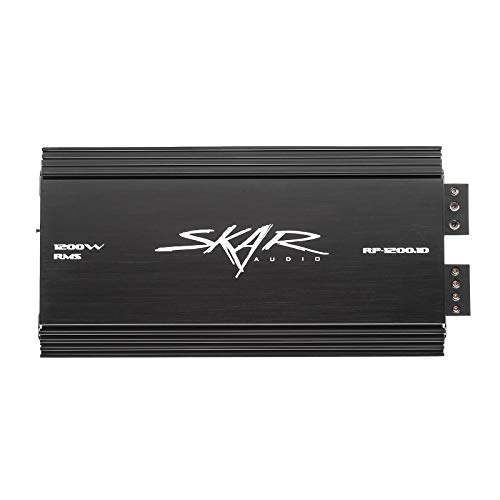
The RP-1200.1D is a Class D MOSFET monoblock rated at 1,200 watts RMS at 1 ohm, with a listed peak rating of 1,600 watts at that load. Its frequency response is 20 Hz to 250 Hz, and its onboard bass EQ offers +6 or +12 dB of boost at 45 Hz.
Best for: A subwoofer system designed to use 1,200 watts RMS at 1 ohm. It was selected as the highest-RMS option among the two Skar RP models here. Check the subwoofer’s RMS requirement and final impedance before choosing it; its listed 1,200-watt figure applies specifically at 1 ohm.
Skar Audio RP-800.1D

This Class D MOSFET amplifier is rated at 800 watts RMS and 1,200 watts peak at 1 ohm. It shares the RP-1200.1D’s listed 20 Hz–250 Hz frequency response and onboard bass EQ, with +6 or +12 dB boost at 45 Hz.
Best for: Buyers whose subwoofer system calls for less 1-ohm RMS power than the RP-1200.1D provides. The matching frequency-response range and bass-EQ options make the two models straightforward to compare. Avoid selecting by peak power alone; compare the 800-watt RMS rating with the subwoofer’s RMS needs.
CT Sounds CT-1000.1D

The CT-1000.1D is a compact Class D amplifier with load-specific RMS ratings: 1,000 watts at 1 ohm, 650 watts at 2 ohms, and 350 watts at 4 ohms, each specified at 14.4 volts. The listing also identifies a frequency response of 0–320 Hz and includes a bass knob.
Best for: Buyers who need a small-footprint amplifier and want listed power ratings across three impedances. Its output changes considerably with load, so use the rating that matches the subwoofer system’s final impedance. The stated power figures are tied to 14.4 volts, which is important context when comparing specifications.
BOSS Audio Systems R1100M

The R1100M is a Class A/B monoblock with a MOSFET power supply. Its listed maximum output is 1,100 watts at 2 ohms and 550 watts at 4 ohms, and it is specified as 2-ohm stable. Features include a low-pass filter, bass boost, remote subwoofer control, and thermal, short-circuit, and overload protection circuits.
Best for: Shoppers seeking a Class A/B design with basic subwoofer controls and protection features. Its listed dimensions are 10.43 by 9.21 by 2.25 inches and its weight is 4.37 pounds, which helps with space planning. The power figures are maximum ratings, not RMS ratings, so compare them carefully with RMS specifications for the subwoofer.
Taramps BASS 400

The Taramps BASS 400 is rated for 400 watts RMS at 2 ohms. Its listed 8 Hz–250 Hz response covers low-frequency use, and adjustable parametric bass boost provides up to +12 dB between 35 and 55 Hz.
Best for: A lower-power daily system or custom build whose subwoofer load and RMS needs match 400 watts at 2 ohms. The bass-boost adjustment gives buyers control over a defined frequency band. Its listed 400-watt output is specifically at 2 ohms; confirm the system’s final impedance rather than assuming the same output at another load.
Buying Guide: How To Choose A Mono Amplifier
How much RMS power does the subwoofer need?
Match the amplifier’s RMS output at the system’s final impedance to the subwoofer’s RMS power requirements. RMS ratings provide a more useful comparison than maximum or peak figures. For example, the Skar RP-1200.1D lists 1,200 watts RMS at 1 ohm, while the BOSS R1100M’s supplied figures are maximum ratings.
What impedance will the amplifier see?
Check the subwoofer voice-coil configuration and wiring plan to determine the final load. Compare that load with the amplifier’s supported impedance and the power rating specified at that impedance. The CT Sounds model lists different RMS output at 1, 2, and 4 ohms, so the appropriate figure depends on the finished wiring configuration.
Should you choose Class D or Class A/B?
These options represent different amplifier designs. The products here include several Class D models and one Class A/B model, the BOSS R1100M. Compare the listed output, physical dimensions, control features, and load requirements rather than choosing by class label alone.
Which controls matter for bass tuning?
A low-pass filter, bass boost, bass EQ, or remote level control can help tailor subwoofer operation. Feature sets differ: the BOSS lists a low-pass filter and remote subwoofer control, while the Skar models specify selectable bass EQ boost at 45 Hz. Read the exact product features and avoid assuming every amplifier includes the same controls.
Frequently Asked Questions
What does a mono car amplifier do?
A mono amplifier provides a single amplifier channel and is commonly selected to power a subwoofer system.
Is RMS or maximum wattage more useful?
RMS power is generally the more useful figure for matching an amplifier to a subwoofer’s continuous power needs. Maximum and peak ratings should not be treated as RMS output.
Can a 1-ohm stable amplifier run a 2-ohm subwoofer load?
Check the amplifier’s specifications for that load and use its stated 2-ohm output. A 1-ohm capability does not mean the amplifier delivers the same power at every impedance.
Does a higher wattage rating always mean better sound?
No. The amplifier’s RMS output, the subwoofer’s power needs, impedance, and system setup all matter. Choose a model that suits the complete system rather than selecting by wattage alone.