Finding the right blade fuse block for 12V–24V systems can simplify wiring, improve safety, and speed up troubleshooting. This article compares five well-rounded options suited for cars, boats, RVs, and small workshops. Each pick targets a common buyer: DIY enthusiasts needing clear layouts, marine users demanding corrosion resistance, and installers seeking durable protection. Use this guide to match your voltage, per-circuit capacity, and enclosure style to your project needs.
Product overview (selected) includes a quick reference to each model’s key strengths and limitations, helping you decide at a glance which is best for you. The table below summarizes core specs and ideal use cases.
| Product | Best For | Per-Circuit Max | Enclosure | Notes |
|---|---|---|---|---|
| ELECTOP 6 Way Fuse Block | Compact 12V installations, DIY enthusiasts | 20A | Waterproof cover; negative bus | New design with clear polarity |
| WUPP 12V Fuse Block | Marine or outdoor apps needing LED fault indicators | 30A | Waterproof, damp-proof cover | LED diagnostics aid quick fixes |
| DAIERTEK 12 Way Fuse Block | 12V/24V vehicles demanding tidy wiring | 30A | Waterproof cover | LED indicator for blown fuses |
| Nilight 6 Way Fuse Block | General automotive and RV uses | 30A | Push-latch cover | Simple, reliable design |
| Blue Sea Systems ST Blade Fuse Block | Higher-demand DC systems with grounds | 30A per circuit; 100A total | Insulating cover | Integrated negative bus and ground |
ELECTOP 6 Way Blade Fuse Block
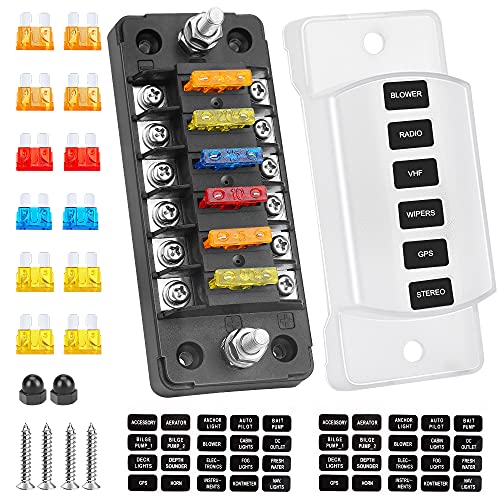
The ELECTOP model supports 1A–20A ATC/ATO fuses and uses separate positive and negative terminals for clear circuit labeling. It is designed for 12V–24V systems with a maximum 32V DC rating and up to 75A for the entire panel. The unit’s PBT construction provides heat resistance and flame resistance, making it suitable for compact power distribution in cars, boats, and ATVs. The included protective cover and DIY sticker set help maintain organization and quick fault finding.
Best for: small to medium 12V installations where a compact six-circuit block with a clear, easy-to-trace wiring layout is needed. It’s a good choice for DIY projects, trailers, and light-duty marine use.
Why chosen: Strong basic protection, organized terminals, and a transparent cover help users quickly identify faults while keeping dust and moisture out.
Caution: While robust, it is not marketed as a heavy-duty or high-current hub. Ensure your total load does not exceed the 75A panel rating.
WUPP 12 Volt Fuse Block

This marine-grade fuse panel features LED indicators for each circuit, helping identify a blown fuse or a short without guesswork. It supports 12V–32V systems with six fuses and six ground connections, keeping wiring neat and accessible. Nickel-plated copper bus bars enhance conductivity and corrosion resistance, making it well-suited for boats, RVs, and harsh automotive environments.
Best for: boaters or RV owners who value quick fault diagnosis and a tidy electrical layout with built-in diagnostic LEDs.
Why chosen: The LED indicators remove ambiguity during troubleshooting, speeding up repairs in tricky environments.
Caution: LED indicators can draw a small residual current with certain test equipment; it may appear as a fault that isn’t present when measured with highly sensitive gear.
DAIERTEK 12 Way Fuse Block

The 12-way DAIERTEK fuse block assigns a dedicated position to each circuit, keeping wiring methodical and tidy. It uses LED indicators to show when a fuse has blown, which helps reduce downtime during maintenance. Rated for up to 32V DC and up to 30A per circuit (100A per panel), it accommodates ATC/ATO fuses and is designed for automotive, marine, and RV use. The protective cover helps guard against moisture and dust.
Best for: users who need clear circuit identification and a higher-per-circuit protection level in 12V/24V vehicles and boats.
Why chosen: The LED fault indication and organized layout improve reliability in mobile installations where space is at a premium.
Caution: The 12-way arrangement means more wiring, so plan routes carefully to avoid tangling and ensure secure grounding.
Nilight 6 Way Fuse Block

The Nilight unit provides six fuse circuits with a negative bus, designed for general automotive and RV needs. It emphasizes a straightforward, dependable design with a clear cover for dust and moisture protection. It is compatible with ATC/ATO blade fuses and suits many everyday wiring projects that require an organized power distribution point in engines bays, trailers, or campers.
Best for: drivers and DIYers seeking a reliable, budget-friendly fuse block for standard 12V systems without specialized diagnostic features.
Why chosen: Practical layout, quick wiring, and solid performance for typical vehicle electrical upgrades or repairs.
Caution: It lacks built-in diagnostic indicators, so you’ll rely on separate testing tools to locate faults in complex circuits.
Blue Sea Systems ST Blade Fuse Block

The Blue Sea Systems ST series offers twelve circuits plus a ground, with an insulating cover and a small integrated spare fuse storage area. It is built to handle higher-demand DC systems and supports up to 100 amps total, with up to 30 amps per circuit when using standard ATO/ATC fuses. Its integrated negative bus and secure cover design support organized, durable marine and automotive installations.
Best for: higher-demand electrical setups requiring a ground/bus layout and robust protection in challenging environments.
Why chosen: The combination of a negative bus, ground integration, and a secure cover makes it a strong fit for complex systems with multiple loads.
Buying Guide
What to consider when choosing a fuse block
- Voltage and current rating: Ensure the panel handles your system’s voltage (12V or 24V) and per-circuit current needs. Check total panel capacity to avoid overloads.
- Number of circuits: Match the number of available slots to your planned circuits. If future expansion is likely, choose a block with more positions than you currently need.
- Enclosure and protection: Look for waterproof or splash-proof covers if your install is exposed to moisture, dust, or salt air. A secure latch helps keep dirt out.
- Polarity and grounding: A negative bus or integrated ground rail simplifies wiring and reduces confusion during maintenance.
- Diagnostics: LED indicators or fault alarms can speed troubleshooting in mobile environments where access is limited.
- Material and safety: Choose flame-resistant, heat-tolerant housings (e.g., PBT) for durability and safety in automotive contexts.
Which features matter most for different buyers
- DIY enthusiasts: Favor clean labeling, a compact footprint, and easy-to-follow wiring with clear polarity.
- Marine users: Prioritize corrosion resistance, waterproof or damp-proof covers, and LEDs for quick fault detection at sea.
- Professional installers: Look for high total panel capacity, robust grounding options, and a design that minimizes wiring clutter in tight spaces.
Installation tips
- Plan wire routes before mounting; group like circuits to simplify troubleshooting.
- Label each circuit on the cover or with DIY stickers for quick identification during maintenance.
- Ground connections should be solid and corrosion-resistant; verify all connections are tight to prevent voltage drops.
- Use heat shrink and correct terminal sizes to reduce overheating risks in high-load circuits.
FAQ
- What is the typical per-circuit limit for these blocks? Most blocks support up to 30A per circuit, with higher total panel capacity on some models.
- Can these blocks be used in boats and RVs? Yes, many models are designed for marine and RV use, with moisture protection and corrosion resistance.
- Do all blocks include a negative bus? Several models feature a built-in negative bus to simplify wiring and improve circuit clarity.
- Are LEDs essential for fault finding? LEDs help identify blown fuses quickly, especially in mobile environments where testing time matters.
- Is a larger panel always better? Not necessarily; choose a panel that fits your current and anticipated future circuits without wasting space.
- Can I use standard ATC/ATO fuses with these blocks? Most blocks are designed for ATC/ATO fuses and require correct fuse ratings for safety.