The best 60 wt motorcycle oil depends on your engine’s required viscosity and how you ride. Maxima V-Twin 60wt is formulated specifically for V-twin engines, while Valvoline VR1 and Red Line 60WT target high-performance and racing use. Lucas SAE 60 Plus is aimed at racing conditions where fuel contamination and heat are concerns. Motul 7100 10W-60 is a motorcycle-specific alternative, but it is a multigrade oil—not straight SAE 60. Always follow the motorcycle manufacturer’s oil specification before choosing.
| Product | Best For | Oil Type |
|---|---|---|
| Maxima V-Twin 60wt | V-twin engines | Mineral, SAE 60 |
| Valvoline VR1 SAE 60 | High-performance gasoline engines | Conventional racing, SAE 60 |
| Red Line 60WT Racing Oil | Specialized racing applications | Synthetic, 60WT |
| Lucas SAE 60 Plus | Racing engines exposed to fuel dilution | Racing oil, SAE 60 |
| Motul 7100 10W-60 | Motorcycles requiring 10W-60 and wet-clutch compatibility | Synthetic ester, 10W-60 |
Maxima V-Twin 60wt Mineral Engine Oil

Best for: Riders whose V-twin engine calls for straight 60-weight mineral oil. Maxima says this oil is formulated specifically for V-twin engines, making it a more targeted choice than a general-purpose racing oil.
Its listed features include a polymer system designed to resist mechanical shearing and heat breakdown, supporting viscosity retention. The formula also includes anti-wear and extreme-pressure additives intended to protect critical engine components. The four-pack contains four 32-ounce bottles.
Limitation: This is mineral-based oil, not a synthetic option. Confirm that mineral SAE 60 is permitted for your engine before choosing it.
Valvoline VR1 Racing SAE 60 Motor Oil
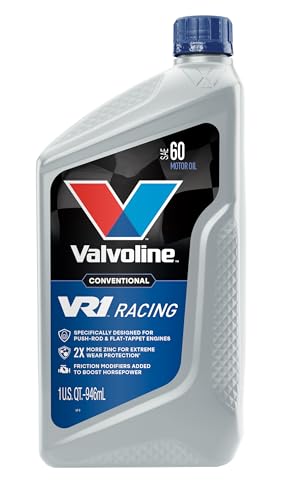
Best for: High-performance gasoline engines and some applications using partial-alcohol fuels, provided the engine manufacturer allows this oil. Valvoline lists track and street service among its intended uses.
The conventional racing formula contains ZDDP, including elevated zinc and phosphorus, for film strength and anti-wear protection on components such as pistons, cams, and bearings. Valvoline also lists anti-foaming agents and resistance to thermal breakdown. Choose this if you want a straight SAE 60 racing oil with features focused on wear protection under stress.
Limitation: Racing-oil additives and a straight 60 grade do not automatically make it suitable for every motorcycle, especially one with a wet clutch. Check the owner’s manual and oil requirements.
Red Line 60WT Racing Oil

Best for: Buyers seeking a 60WT synthetic racing oil for specialized competition or high-load applications. The listed uses include Top Alcohol and Pro Mod classes, AHDRA Nitro bikes, and blown-alcohol tractor pulling.
Red Line identifies improved valvetrain wear, reduced piston scuffing, and improved bearing wear as product benefits. Its listing also says the oil can be heated to evaporate fuel dilution and reused. That unusual feature may appeal to specific racing users, but it should not be treated as a general maintenance practice without confirming suitability for the application.
Limitation: The listed competition uses do not establish compatibility with every street motorcycle or wet-clutch system. Verify the motorcycle’s requirements before use.
Lucas Oil SAE 60 Plus Racing Oil

Best for: Racing applications where the buyer is looking for a straight SAE 60 oil with features aimed at fuel contamination and high crankcase temperatures.
Lucas says the formula has extra additives compared with regular racing oils. Its listed benefits include resistance to breakdown from racing-fuel contamination and resistance to oxidation and thinning at high crankcase temperatures. The five-quart package may suit buyers who need more oil on hand than a single-quart container provides.
Limitation: The supplied product details do not specify motorcycle or wet-clutch compatibility. Do not assume those uses are approved; check the manufacturer’s guidance for your bike.
Motul 7100 10W-60 Motorcycle Oil

Best for: Motorcycle owners whose manufacturer specifies 10W-60 and who need oil identified as wet-clutch compatible. Motul lists JASO MA2 performance and API SP, along with a 100% synthetic ester formulation.
The product is designed for four-stroke motorcycle engines, with listed features addressing clutch engagement, shifting, high-RPM use, and high-temperature protection. Its 10W-60 grade combines a winter viscosity rating with a 60 high-temperature rating, so it is not interchangeable with straight SAE 60 simply because both include “60.”
Limitation: Choose it only when 10W-60 matches the motorcycle’s specification. The listed four-liter size may also be more than some owners need for a single service.
Buying Guide: How to Choose 60 Wt Motorcycle Oil
Does your motorcycle require straight SAE 60 or 10W-60?
These grades are different. Straight SAE 60 is a single-grade oil. SAE 10W-60 is a multigrade oil tested to meet specified cold-temperature and high-temperature viscosity requirements. Do not select one based only on the shared “60.” Use the viscosity listed in your owner’s manual or service information.
Is the oil intended for your engine and clutch?
Some listings describe racing or automotive-oriented applications, while Maxima and Motul specifically identify motorcycle-related uses. For a motorcycle with a shared engine, gearbox, and wet clutch, confirm the oil meets the requirements for that system. A racing label alone does not prove clutch compatibility.
Should you choose mineral, conventional, or synthetic oil?
Maxima’s listed product is mineral-based, Valvoline VR1 is conventional racing oil, and Red Line and Motul list synthetic formulations. Match the oil type to the manufacturer’s recommendation and the intended service. Do not treat synthetic oil as a substitute for the correct viscosity or specification.
What matters for hot or racing conditions?
Look at the specific features rather than relying on broad performance language. The listed products emphasize different priorities: Maxima highlights shear and heat-breakdown resistance, Valvoline highlights anti-wear additives and thermal stability, and Lucas emphasizes resistance to fuel contamination and high-temperature thinning.
How much oil should you buy?
Compare package quantity with your motorcycle’s service-fill requirement and how often you maintain it. The products range from a single liter to multi-bottle or multi-quart packages. Store oil according to its label and avoid choosing a larger pack unless you can use and store it appropriately.
Frequently Asked Questions
Is SAE 60 oil the same as 10W-60?
No. SAE 60 is a single-grade designation, while 10W-60 is a multigrade designation with additional low-temperature viscosity classification. Follow the grade specified for your motorcycle.
Can I use 60 wt racing oil in a street motorcycle?
Only if the oil’s specifications and intended use meet the motorcycle manufacturer’s requirements. Racing positioning by itself does not confirm street, engine, or wet-clutch compatibility.
Which option is specifically formulated for V-twin engines?
Maxima V-Twin 60wt is described as a mineral-based motorcycle oil specifically formulated for V-twin engines. Confirm that its grade and oil type match your engine’s requirements.
Does “60 wt” guarantee wet-clutch compatibility?
No. Viscosity does not establish clutch compatibility. Check the oil’s listed motorcycle specifications and your owner’s manual.