For an engine that specifies SAE 5W-40, Valvoline European Vehicle, Mobil 1 Turbo Diesel Truck, and Castrol EDGE Euro are the most directly relevant choices here. Mobil 1 FS 0W-40 is a nearby viscosity alternative, while Mobil 1 Advanced Fuel Economy 0W-20 is included only as a contrast—not as a 5W-40 substitute. Always match the oil viscosity and required specifications in your owner’s manual.
| Product | Best For | Viscosity |
|---|---|---|
| Valvoline European Vehicle | European gasoline and diesel engines | 5W-40 |
| Mobil 1 Turbo Diesel Truck | Modern diesel truck engines | 5W-40 |
| Castrol EDGE Euro | European vehicles needing 5W-40 A3/B4 | 5W-40 |
| Mobil 1 FS European Car Formula | Engines specifying 0W-40 | 0W-40 |
| Mobil 1 Advanced Fuel Economy | Engines specifying 0W-20 | 0W-20 |
Valvoline European Vehicle 5W-40

Best for: Drivers of European gasoline or diesel vehicles whose manuals call for 5W-40 and the relevant oil requirements. It is selected because it combines the requested viscosity with features aimed at European engines.
Valvoline says the full synthetic oil helps protect against wear, friction, heat, and deposits. Its low-SAPS formulation is intended to be compatible with emissions systems, and the product description cites high- and low-temperature protection for varied driving conditions and climates.
Consideration: Low-SAPS wording alone does not confirm that the oil meets your vehicle’s specific approval. Check the owner’s manual and oil-container specifications before buying.
Mobil 1 Turbo Diesel Truck 5W-40

Best for: Modern diesel truck engines that specify 5W-40. This product is selected for its diesel-focused formulation and stated suitability for demanding, high-performance diesel applications.
Mobil describes it as offering long-drain capability and performance for modern diesel truck engines, including low-emission applications. The company also says it meets or exceeds demanding specifications from major truck manufacturers and can be used in mixed-fleet operations.
Consideration: “Long drain” does not set the correct oil-change interval for every truck. Follow the vehicle maker’s maintenance schedule and confirm the oil’s required specification.
Castrol EDGE Euro 5W-40 A3/B4

Best for: Owners whose vehicle calls for 5W-40 and the A3/B4 specification. The product is selected because its listed name identifies both the viscosity and that specification, making it easier to compare against a manual.
Castrol reports 1.2 times better viscosity control and twice better engine cleanliness, measured in a DV6 test against the test limit. Those are the manufacturer’s stated test comparisons, not a guarantee of a particular result in every engine.
Consideration: The listing is a six-pack of one-quart containers, so it may be less convenient than a larger single container for some oil changes. Confirm the required oil specification before choosing it.
Mobil 1 FS European Car Formula 0W-40

Best for: European-car owners whose manuals specify 0W-40, not 5W-40. It is included as a nearby viscosity comparison, but it is not a direct replacement for the requested grade.
Mobil highlights low-temperature performance for rapid protection at startup and protection against engine wear and deposits. Its listing also states a 15,000-mile protection guarantee; use the vehicle manufacturer’s service interval rather than assuming that mileage applies to every car.
Consideration: The “0W” winter grade differs from 5W. Choose this oil only when the vehicle’s requirements permit 0W-40.
Mobil 1 Advanced Fuel Economy 0W-20
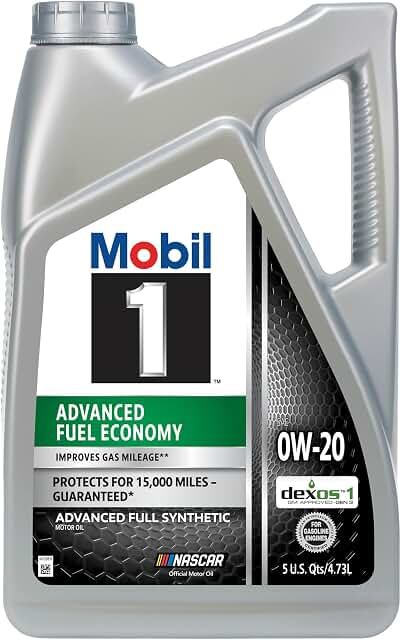
Best for: Drivers whose engines specifically require 0W-20 and who want an oil marketed for fuel economy. It is included as a contrast, not as a 5W-40 recommendation.
Mobil says the oil helps increase engine efficiency and improve gas mileage. Its product description also states a 15,000-mile protection guarantee. These claims do not make it suitable for an engine that requires 5W-40.
Consideration: The viscosity is substantially different from 5W-40. Avoid it unless the owner’s manual allows 0W-20.
Buying Guide: How To Choose 5W-40 Full Synthetic Oil
Does your vehicle require SAE 5W-40?
Start with the owner’s manual or the vehicle manufacturer’s maintenance information. Match the specified viscosity first. A nearby grade such as 0W-40 or 0W-20 is not automatically interchangeable with 5W-40.
Which engine type do you have?
For a European gasoline or diesel engine, Valvoline’s European-focused formula is a relevant option when its specifications match. For a modern diesel truck, Mobil 1 Turbo Diesel Truck is the more targeted choice. Castrol EDGE Euro is a comparison option when the vehicle calls for A3/B4.
What specifications and formulation details matter?
Check for the exact approvals or performance specifications required by the automaker, not just the viscosity printed on the front label. Low-SAPS formulation may matter for emissions-system compatibility, but verify the specific vehicle requirement rather than relying on a general description.
How should you compare container formats and claims?
Consider how much oil your vehicle needs and whether you prefer a larger container or multiple smaller bottles. Treat mileage and protection statements as product claims, not universal oil-change intervals. Follow the maintenance schedule for your vehicle and driving conditions.
Frequently Asked Questions
What does 5W-40 mean?
It is an SAE viscosity grade. The “5W” describes the oil’s winter-grade behavior, and “40” identifies its operating-temperature viscosity grade. Use the grade specified for your engine.
Can I use 0W-40 instead of 5W-40?
Only if the vehicle manufacturer permits 0W-40 for your engine and climate. Check the owner’s manual; the two grades should not be assumed interchangeable.
Is 5W-40 suitable for diesel engines?
Some diesel engines specify 5W-40, including certain truck applications. Confirm the required oil specification and approvals for your particular engine.
Does full synthetic oil mean longer oil-change intervals?
Not necessarily. Follow the vehicle maker’s maintenance schedule, even when the oil product advertises extended protection or long-drain capability.
Can 0W-20 be used in an engine that calls for 5W-40?
Do not substitute 0W-20 unless the manufacturer explicitly allows it. It is a different viscosity grade and is not a direct alternative to 5W-40.