A 12V voltage stabilizer can provide regulated power to compatible vehicle electronics when the input voltage varies. The EKYLIN and RQG models are best for higher-current devices, DROK offers a lower 5A capacity with multiple protections, and Cocar suits 4A loads. XWST is intended for lower-power equipment. Compare input range, output capacity, and environmental protection before choosing.
| Product | Output rating | Best for |
|---|---|---|
| EKYLIN | 12A, 144W | Higher-power vehicle electronics |
| DROK | 5A, 60W | Moderate loads and added protections |
| Cocar | 4A, 48W | Outdoor use with smaller loads |
| RQG | 12A, 144W | High-current applications with listed safeguards |
| XWST | 2A, 24W | Low-power electronics |
EKYLIN 12A 144W Voltage Stabilizer
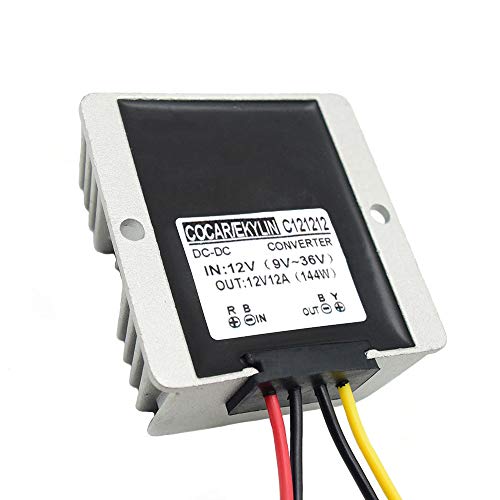
The EKYLIN regulator accepts DC 10–36V input and supplies 12V DC output, with a maximum current of 12A and rated power of 144W. Its broad input range makes it suitable for vehicle and other listed DC systems where the source voltage may vary.
Best for: Buyers powering higher-current 12V equipment, such as vehicle displays, audio equipment, or monitoring systems, as long as the device’s power requirements stay within the stated rating. It was selected for its comparatively high listed output capacity and IP67 waterproof design.
The product uses heat-conducting silicone gel filling and sealing and is described as suitable for outdoor conditions. Limitation: The listed input range begins at 10V, so it is not the best match if the application requires operation below that level.
DROK 5A Waterproof DC-DC Stabilizer

DROK’s converter accepts DC 9–36V and outputs 12V at up to 5A, with a maximum listed power of 60W. It is described as a boost-buck converter, which is designed to regulate output when input voltage is above or below the target voltage within its specified range.
Best for: Buyers with moderate-power 12V loads who want listed over-current and over-temperature protection. Its potted construction is described as waterproof, dustproof, moisture-proof, and shock-proof, and the product is listed for applications including car audio, displays, and solar power systems.
Limitation: Its 5A, 60W rating is substantially lower than the 12A models in this roundup. Check the connected equipment’s maximum draw before selecting it.
Cocar 4A 48W Waterproof Regulator

The Cocar stabilizer accepts DC 10–36V input and provides 12V output at up to 4A, or 48W. The manufacturer describes it as protection against unstable voltage and electrical surges, including fluctuations associated with older vehicle batteries.
Best for: Drivers and RV, boat, or camper owners powering compatible devices that draw no more than 4A. It was selected for its clearly stated rating and rugged IP67 waterproof alloy housing, which is sealed with heat-conduction silica gel.
Compare its 4A capacity with the load requirements rather than choosing it based only on the 12V output. Limitation: It is not intended for equipment whose current or power demand exceeds the listed maximum.
RQG 12A 144W DC Voltage Stabilizer

The RQG regulator accepts DC 9–36V and provides 12V output at up to 12A and 144W. The listed features include an IP67 housing, heat-conductive silicone-gel sealing, and over-temperature, output over-voltage, output over-current, and short-circuit protection. The manufacturer also states conversion efficiency of up to 96%.
Best for: Buyers who need a higher-current stabilizer and want the listed output-side safeguards for vehicle, marine, or mobile power applications. It was selected for combining a broad input range with a 12A output rating.
Limitation: The product information specifically says it does not provide input-side reverse-polarity or short-circuit protection. Confirm wiring polarity and consider appropriate upstream protection for the installation.
XWST 2A 24W Low-Power Stabilizer

XWST’s DC-DC converter accepts DC 9–36V and supplies 12V at up to 2A, with a maximum listed power of 24W. It includes over-current and over-temperature protection. Its potted design is described as waterproof, dustproof, moisture-proof, and shock-proof.
Best for: Buyers powering lower-demand equipment, such as compatible small displays or audio components, within the 2A limit. It was selected to provide a clearly specified lower-capacity option alongside the higher-output models.
Limitation: Its 24W maximum makes it a poor choice for devices with larger power demands. Check both the connected device’s current and startup requirements before installation.
Buying Guide: How To Choose A 12V Car Stabilizer
How much output capacity do you need?
Check the connected device’s voltage, current, and power requirements. A 12V output alone does not guarantee a match: the stabilizer must also support the device’s current draw. Compare the stated maximums in this article, and avoid operating a converter beyond its rating.
What input-voltage range should you look for?
Choose a model whose input range covers the voltage your source can provide. The products listed here accept ranges from 9–36V or 10–36V. A wider range can offer more flexibility, but it does not replace confirming the actual electrical conditions of the installation.
Does waterproofing or protection matter?
For locations exposed to rain, dust, moisture, or vibration, compare the product’s stated enclosure and construction. Several models list IP67 protection or potted, sealed construction. Protection features differ: review whether safeguards apply to input, output, temperature, or current rather than assuming every type is included.
How should you compare similar 12A models?
EKYLIN and RQG both list 12A and 144W output. Their input ranges differ: EKYLIN lists 10–36V, while RQG lists 9–36V. RQG also specifies output over-voltage, over-current, and short-circuit protection, while noting that input-side reverse-polarity and short-circuit protection are absent. Choose according to the application’s input range and protection needs.
Frequently Asked Questions
What does a 12V voltage stabilizer do in a car?
It regulates a variable DC input to provide a specified 12V output for compatible equipment. It does not make an incorrectly rated device safe to connect.
Can I use any 12V stabilizer for a car accessory?
No. Match the stabilizer’s input range and output-current capacity to the power source and accessory requirements before installation.
Is a higher amp rating always better?
Not necessarily. The stabilizer must meet the device’s requirements, but a larger current rating does not establish compatibility with every vehicle or accessory.
Can these models be installed outdoors?
Several list waterproof or sealed construction, but suitability depends on the specific model and installation conditions. Follow the product’s instructions and protect electrical connections appropriately.