Find the right 0W-30 full synthetic motor oil for your vehicle. This guide highlights top options that balance fuel efficiency, engine protection, and performance in a variety of driving conditions. Best for newer engines, high-performance builds, and vehicles requiring low-viscosity protection with long-change intervals.
| Product | Brand | Ideal For | Why It Stands Out |
|---|---|---|---|
| Mobil 1 Advanced Fuel Economy Full Synthetic Motor Oil 0W-30 | Mobil | Fuel-conscious drivers and newer engines | Low viscosity for improved fuel economy; triple action formula for performance and cleanliness |
| Mobil 1 96918 0W-30 Synthetic Motor Oil | Mobil | Vehicles needing strong high/low-temp protection | Excellent wear protection and sludge control; works from -53ºF to 400ºF |
| Pennzoil Platinum Euro LX 0W-30 | Pennzoil | European engines and long-term protection | Natural gas-based base oil; extends engine life with up to 15 years or 500,000 miles guarantee* |
| LIQUI MOLY Special Tec V 0W30 | Liqui Moly | Modern diesels and gasoline engines with high load demand | Designed for long oil-change intervals; versatile for Volvos and multi-valve engines |
| Castrol GTX Full Synthetic 5W-30 | Castrol | Broad engine types needing strong protection | Excellent wear and sludge protection; strong viscosity stability |
Note: This guide focuses on 0W-30 full synthetic options, with closely related grades included for comparison where relevant.
Mobil 1 Advanced Fuel Economy 0W-30 — Best for Fuel Economy

Features: Low-viscosity 0W-30 to improve fuel economy. Mobil 1’s Triple Action Formula delivers engine performance, protection, and cleanliness. Suitable for up to 10,000 miles between changes and resists oxidation to maintain viscosity.
Best for: Drivers seeking maximum fuel efficiency without sacrificing protection in modern engines. Particularly advantageous for daily commuters and vehicles designed with strict fuel economy targets.
Limitation: While optimized for fuel economy, some older engines may not benefit as much from ultra-low viscosity blends. Confirm manufacturer recommendations before use.
Mobil 1 0W-30 Synthetic Oil — All-Weather Performer

Features: Outstanding wear protection; improved sludge and deposit control; excellent high- and low-temperature performance, pouring at -53ºF and protecting up to 400ºF oil temps.
Best for: Vehicles operating in extreme temperatures or with challenging driving cycles where reliable protection across a wide temperature range matters.
Limitation: Pack size may require multiple quarts for some engines; review capacity and replacement interval recommendations.
Pennzoil Platinum Euro LX 0W-30 — European Engine Protection
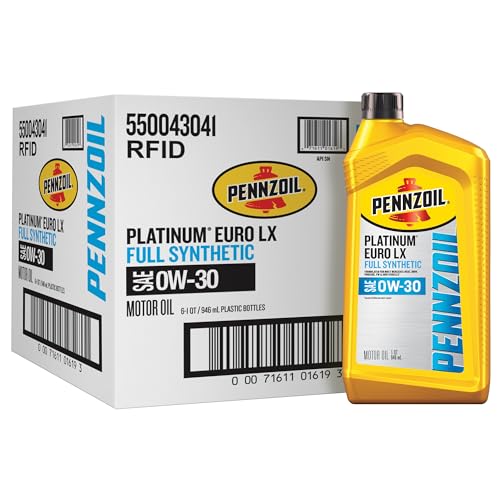
Features: Full synthetic 0W-30 made with natural gas; designed for high-performance European engines ( Fiat, BMW, Mercedes-Benz, Porsche, VW ); helps extend engine life and offers long-term protection for up to 15 years or 500,000 miles (whichever comes first).
Best for: European cars requiring 0W-30 with advanced protection and long-term performance expectations. Choose this if you own a European model that specifies 0W-30 and you want durable protection.
Caution: Long-term mileage claims are broad; verify with your vehicle’s maintenance schedule and warranty requirements.
LIQUI MOLY Special Tec V 0W30 — High-Load diesel and petrol

Features: Optimally suited for state-of-the-art diesel and petrol engines with multi-valve technology; supports long oil-change intervals and high engine loads; developed for Volvo applications among others.
Best for: Engines with modern variable-valve timing, turbochargers, or diesel particle filters that benefit from robust protection at low viscosity. Good for long intervals and challenging road conditions.
Limitation: Availability varies by market; ensure compatibility with your vehicle and regional oil standards.
Castrol GTX Full Synthetic 0W-20 vs 5W-30 Comparison

Features: 6X better wear protection on critical engine parts than industry standards; 1.3X better sludge protection; 3X stronger against viscosity breakdown versus leading full synthetic.
Best for: Those who require reliable wear protection and sludge control for a range of engines. If you specifically need 0W-30 for a given model, verify the exact grade required, as Castrol GTX offerings span multiple viscosities.
Limitation: The product shown is 0W-20-focused in some listings; confirm the exact viscosity grade before purchasing to avoid mismatched oil for your engine.
Buying Guide: Choosing the Right 0W-30 Full Synthetic Oil
- Engine type and manufacturer recommendations: Always check your owner’s manual for the recommended viscosity grade (0W-30) and whether the engine requires a specific synthetic formulation.
- Climate and driving conditions: If you face extreme cold or heat, prioritize oils with proven wide-temperature performance (e.g., -53ºF to 400ºF ranges).
- Maintenance intervals: Some oils advertise long-change intervals; confirm your vehicle’s service schedule and avoid extending beyond manufacturer guidance.
- Fuel economy goals: Low-viscosity 0W-30 formulations can aid fuel efficiency in compatible engines, but benefits depend on engine design and driving style.
- European vs. domestic engines: Some 0W-30 formulations are tailored for European engines with high performance requirements; verify compatibility with your model.
- Oil protection features: Look for additives that combat oxidation, sludge formation, and deposit control for long-term engine cleanliness.
- Availability and packaging: Consider quart packs vs. multi-quart cartons for your vehicle’s oil capacity and replacement frequency.
FAQ
- Is 0W-30 full synthetic good for all engines? It’s best for engines designed for low-viscosity oils. Always follow the vehicle manufacturer’s recommended grade.
- How often should I change oil with 0W-30 synthetic? Change intervals vary by vehicle and oil specification; check the owner’s manual and oil life monitoring system if present.
- Can I mix 0W-30 with a different viscosity? Mixing viscosities is not recommended; use the grade specified for your engine to maintain protective performance.
- Are there benefits to the claims like “sludge protection”? Yes, many full synthetic formulas include additives to reduce sludge and maintain viscosity, contributing to cleaner engines.
- Do European engines require a specific 0W-30? Some European engines have strict specifications; verify compatibility with approvals like VW 502.00, BMW LL-01, or Fiat approvals as applicable.
- What’s the best 0W-30 for extreme climates? Oils tested across broad temperature ranges (extreme cold and heat) are suitable for such climates; check for cold pour point and high-temperature stability.